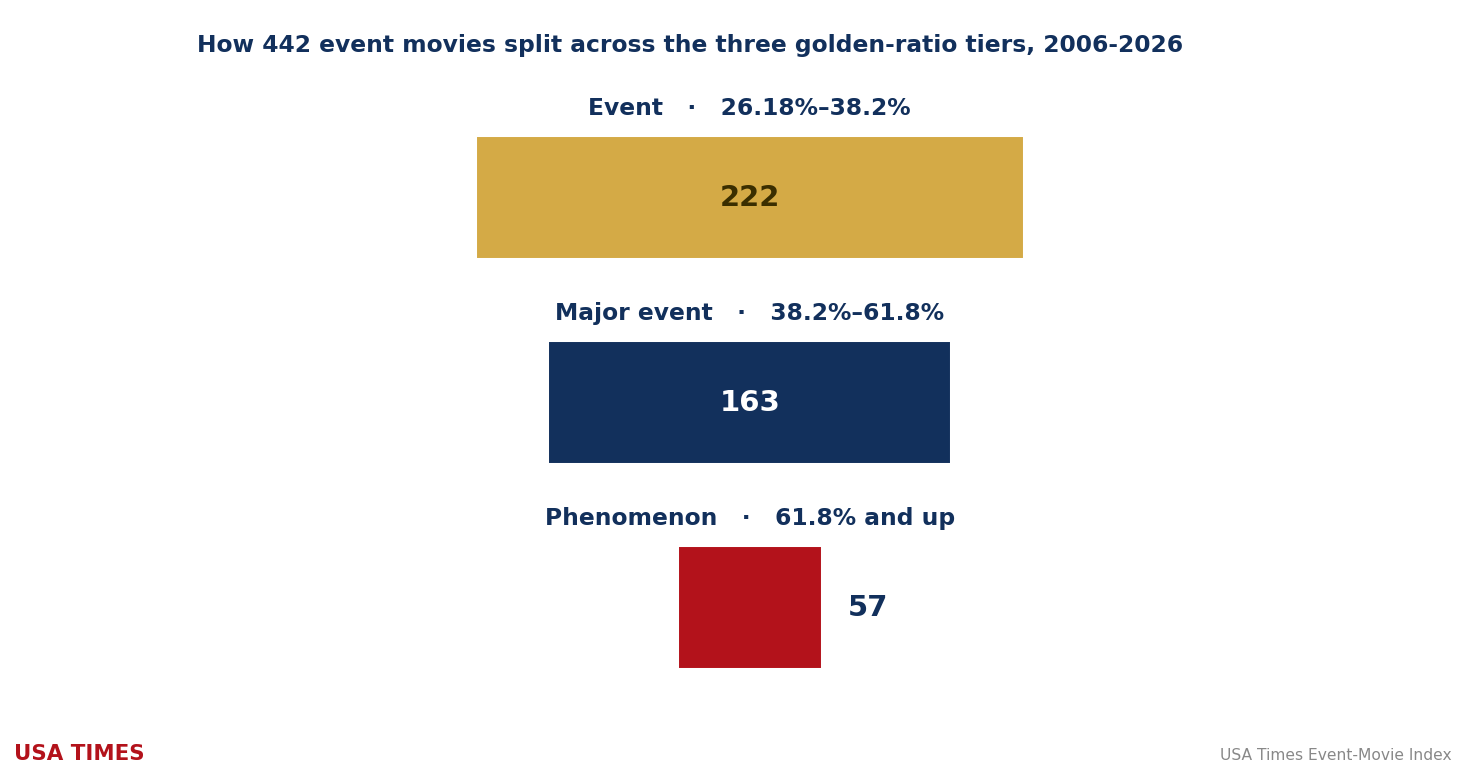
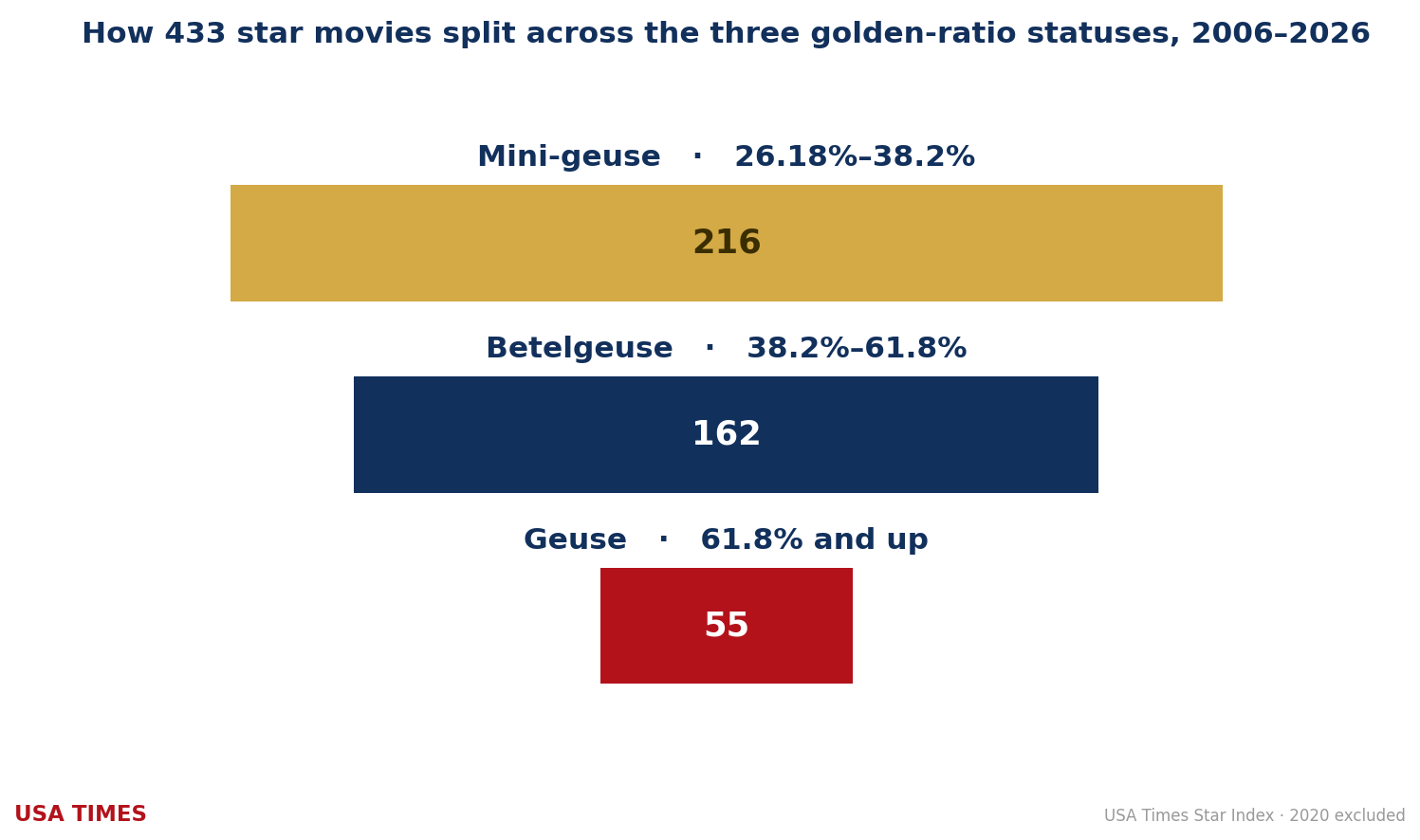
The USA Times Star Index rests on three thresholds, all drawn from the golden ratio: 26.18% to be a Mini-geuse, 38.2% to be a Betelgeuse, and 61.8% to be a Geuse — each figure a share of the entire U.S. box office in a single week. It is one thing to define the tiers. It is another to see how the twenty-year field actually distributes across them. The answer is a pyramid, and its shape says a lot about how rare true domination really is.
Wide base, sharp point
Of the 442 films that qualified as star movies since 2006, 222 topped out as Mini-geuses, 163 reached Betelgeuse, and only 57 ever became a Geuse. Read from the top down, the funnel is brutal: most films that manage to own a week do so modestly, taking somewhere between a quarter and a bit over a third of the market. Fewer than one in three climb into the commanding Betelgeuse band, and just one in eight of all star movies — a razor-thin sliver — ever seize the near-total, 61.8%-plus grip that defines a Geuse.
Are the tiers themselves golden?
Here is a question a numerically minded reader will ask immediately: if the thresholds come from the golden ratio, do the counts follow it too? It would be a satisfying story if each tier were 1.618 times the one above it. It is not. There are about 1.4 Mini-geuses for every Betelgeuse, and about 2.9 Betelgeuses for every Geuse. Neither ratio is φ, and we are not going to pretend otherwise. The golden ratio sets the boundaries of the tiers; it does not dictate how many films fall inside each one. That is decided by the messy realities of release schedules, franchise cycles, and how much competition a given weekend happens to hold.
Batmandir · Guest Passes Step inside for a day. Guest passes from $161/day — brought in by a member. See guest passes →This is worth stating plainly because the internet is full of golden-ratio claims that quietly move the goalposts until the number fits. We use φ for one specific, defensible reason: it produces clean, non-arbitrary cut points (26.18, 38.2, 61.8) that split “dominance” into three intuitive bands. What lands in those bands is an empirical fact about the movie business, and it happens not to be golden. Both things can be true.
Why the point is so sharp
The scarcity of Geuses is the most telling feature of the pyramid. To take 61.8% of a week, a film needs two things at once: an enormous opening, and an unusually empty field around it. The first is achievable for any megabudget franchise. The second is a matter of scheduling nerve — opening on a weekend that rivals have deliberately vacated. Only a handful of titles each year command that kind of runway, which is why the top of the pyramid stays so small even as the movies at the base have grown larger.
And yet the base is not shrinking. The Mini-geuse and Betelgeuse tiers together account for the overwhelming majority of the field, and they represent the everyday reality of the box office: strong films opening well and dominating decisively without erasing the competition entirely. The pyramid’s shape — broad and gently tapering, then spiking to a fine point — is a fair picture of modern moviegoing. Domination is common. Total domination is not.
One caveat keeps the picture honest: these tiers describe a single week’s share, not a film’s whole life. A movie can sit in the Mini-geuse tier on a crowded weekend and still out-earn a Geuse that peaked on an empty one. The pyramid ranks how completely films owned their moment — a real and revealing thing, but not the same as how much they ultimately made, or how good they were.
The denominator does half the work
Every tier in the pyramid is a fraction, and it is easy to forget that a fraction has two halves. A film’s weekly share rises when its own gross rises, but it rises just as surely when everyone else’s gross falls. That second lever is the quiet engine behind most Geuse weeks. A $150 million opening on a weekend where the rest of the market brings in $100 million is a Geuse; the same $150 million opening against $250 million of competition is a Betelgeuse at best. Nothing about the film changed. The room it walked into did.
This is why the pyramid should be read as a measure of circumstance as much as of strength. Studios understand the denominator intimately, which is why release dates are claimed years in advance and why a single date change from a rival can ripple through an entire calendar. The counting exercise above is, in part, a record of how well those scheduling negotiations went. A thin field is not luck; it is often the product of a dozen competitors deciding, one by one, that a particular weekend was not worth contesting.
How the calendar shapes the tiers
The distribution across tiers is not spread evenly through the year. The structural logic of the release calendar all but guarantees that. Summer and the December holidays pack the schedule with tentpoles, so a big film in those windows is usually competing against another big film and settles into the Mini-geuse or Betelgeuse bands. The quieter shoulders of the year — late winter, early spring, the stretch after Labor Day — are where a single well-marketed release can find the market nearly to itself. It is no accident that the same tiers that feel unreachable in July can be reached with a smaller absolute gross in February.
The practical consequence is that the pyramid rewards two very different strategies. One is brute force: open so large that even a crowded weekend cannot dilute you. The other is positioning: find the gap in the calendar and fill it. The first strategy produces the famous Geuses everyone remembers. The second produces the ones that surprise people when they see the list — films whose share of the market vastly exceeded their share of the cultural conversation, because they had the good sense to show up when nobody else did.
What the tiers do not tell you
A share-of-market metric carries limitations that deserve to be spelled out rather than footnoted. First, it is blind to scale. The total U.S. box office in a given week can swing by a factor of two or three between a dead weekend in January and a peak summer frame, so a 40% share in one can represent far less money than a 30% share in the other. Second, a “week” is itself a construct. Whether a film opens on Wednesday, Thursday night, or Friday changes what counts inside the window, and holiday frames stretch and compress the period in ways that flatter some films and penalize others. Third, the metric says nothing about legs. A front-loaded franchise entry that collapses 70% in its second weekend can post a higher peak share than a slow-building word-of-mouth hit that never owns a single week but plays for three months.
None of this makes the pyramid wrong. It makes it specific. The Star Index asks one question — how completely did a film own its best week? — and answers it cleanly. Readers who want to know how much a film earned, how long it lasted, or how it was received will need other instruments. The value of the tiers is precisely that they do not try to be all of those things at once.
Concentration, seen from the other side
Economists who study markets have their own vocabulary for what the pyramid describes. A Geuse week is a highly concentrated market: one product accounting for more than three-fifths of all sales. In most industries that level of concentration would draw regulatory attention. In theatrical film it is simply a good weekend, and it is fleeting — by definition, the same market is reshuffled seven days later. That impermanence is what makes the movie business an unusual laboratory for concentration. The same screens, the same theaters, the same audience pool produce a near-monopoly one week and a fragmented, competitive field the next.
Seen this way, the base of the pyramid is arguably the healthier signal for the industry as a whole. A calendar full of Mini-geuses means many films are opening well enough to lead, and none is starving the rest. A calendar dominated by Geuses would mean a handful of titles absorbing nearly all of the money in their weeks, with everything else fighting over scraps. The rarity of the top tier, then, is not only a testament to how hard total domination is. It is also a sign that, most weeks, there is still room for more than one movie.
Where the pyramid goes from here
Two forces will pull on the shape of the pyramid in the coming years, and they pull in opposite directions. Shorter theatrical windows and the migration of mid-budget films to streaming have thinned the field around tentpoles, which should make Geuse weeks easier to achieve for the biggest releases. At the same time, studios have grown more cautious about dating their tentpoles against one another, spreading them across the calendar and reducing the number of weekends where any single film can claim the whole market unopposed. Whether the point of the pyramid sharpens or dulls will depend on which of those tendencies wins out.
The Star Index will keep counting either way. The thresholds are fixed, which is the whole point: they do not move with the market, so the market’s movement shows up in the counts. If the Geuse tier begins to swell, that will tell us something about the emptying of the calendar. If the base broadens further, that will tell us the field is getting more crowded, not less. The pyramid is a snapshot of twenty years; its real value will come from watching how the next twenty redraw it.