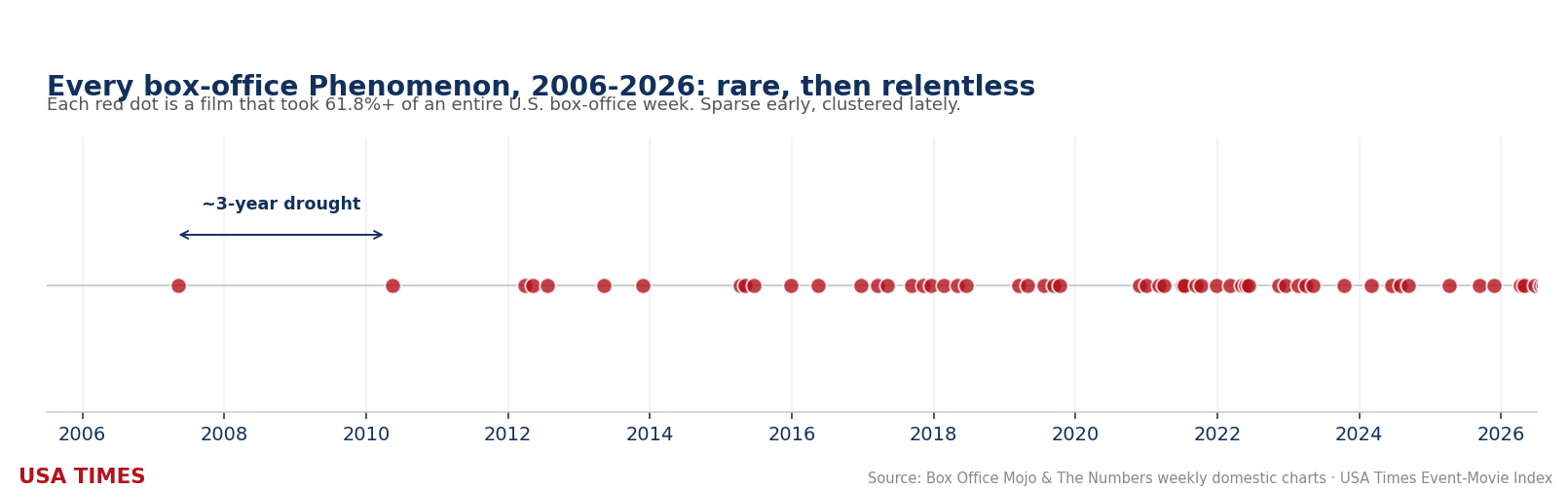
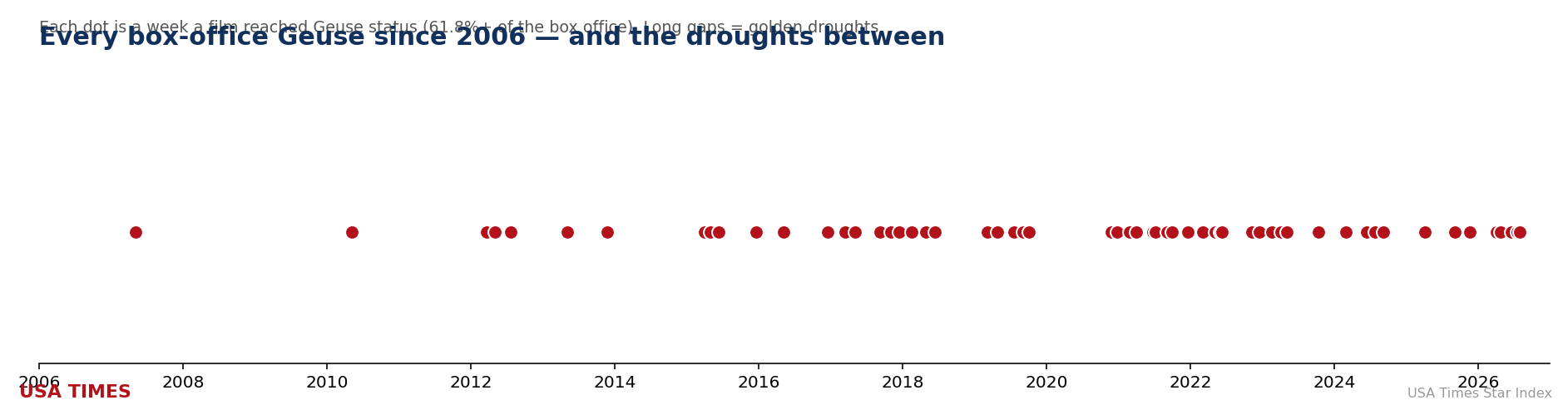
A Geuse — a single film taking 61.8% or more of an entire week’s U.S. box office — is the rarest event the USA Times index tracks. There have been just 57 of them in twenty years. But they have not arrived on any kind of schedule. For long stretches, none came at all; then several would land in a single season. Plot them on a timeline and you can see the whole modern history of box-office concentration in a single row of dots.
The great early drought
The longest gap of all runs through the late 2000s: a drought of roughly three years in which not one film managed to seize 61.8% of a week. The blockbusters of that era were plenty big, but the market was genuinely shared — a huge opener still left three or four other wide releases pulling real crowds, so no single film could vacuum up nearly two-thirds of everything. Total domination simply wasn’t available; there was too much competition in the room.
| Drought | After this Geuse | The next one |
|---|---|---|
| 157 weeks | Spider-Man 3 (2007) | Iron Man 2 (2010) |
| 97 weeks | Iron Man 2 (2010) | The Hunger Games (2012) |
| 71 weeks | The Hunger Games: Catching Fire (2013) | Furious 7 (2015) |
| 59 weeks | Joker (2019) | The Croods: A New Age (2020) |
| 41 weeks | The Dark Knight Rises (2012) | Iron Man 3 (2013) |
| 38 weeks | Incredibles 2 (2018) | Captain Marvel (2019) |
| 32 weeks | Captain America: Civil War (2016) | Rogue One: A Star Wars Story (2016) |
| 30 weeks | Beetlejuice Beetlejuice (2024) | A Minecraft Movie (2025) |
From famine to feast
The right-hand side of the timeline could hardly look more different. In recent years the dots crowd together — multiple Geuses per year, sometimes back-to-back. The famine turned into a feast not because movies got bigger in some absolute sense, but because the field around them thinned. As mid-budget films migrated to streaming and studios concentrated their bets on a shrinking set of tentpoles, more and more of those tentpoles found themselves opening into near-empty weekends, where clearing 61.8% became achievable. The drought ended when the competition did.
We should be careful not to over-read the earliest gaps. Weekly box-office record-keeping is cleanest from the late 2000s onward, and the theatrical calendar itself has shifted, so a drought measured in 2007 is not a perfectly clean comparison with one measured in 2023. But the broad shape is unmistakable and consistent with everything else the index shows: Geuses used to be freak occurrences separated by years, and they have become a regular feature of the calendar. The rarest thing in moviegoing is, quietly, no longer that rare.
There is a certain irony in it. The golden ratio gave us a fixed, unchanging line — 61.8% — precisely so we could measure a moving target. What the timeline reveals is how much the target has moved: the same threshold that almost nothing could reach in 2008 is now cleared several times a year. The line held still. The box office rearranged itself around it.