Open any cinematography tutorial and you will eventually meet the golden spiral: that elegant curve, coiling in on itself, laid over a famous film still to reveal how the director “secretly” placed the hero’s eye exactly on the sweet spot. It is a seductive idea — that the greatest shots in cinema obey the same proportion as a nautilus shell. It is also, more often than not, a trick of hindsight. But there is a real craft question underneath the mysticism, and it is worth taking seriously.
Thirds versus phi
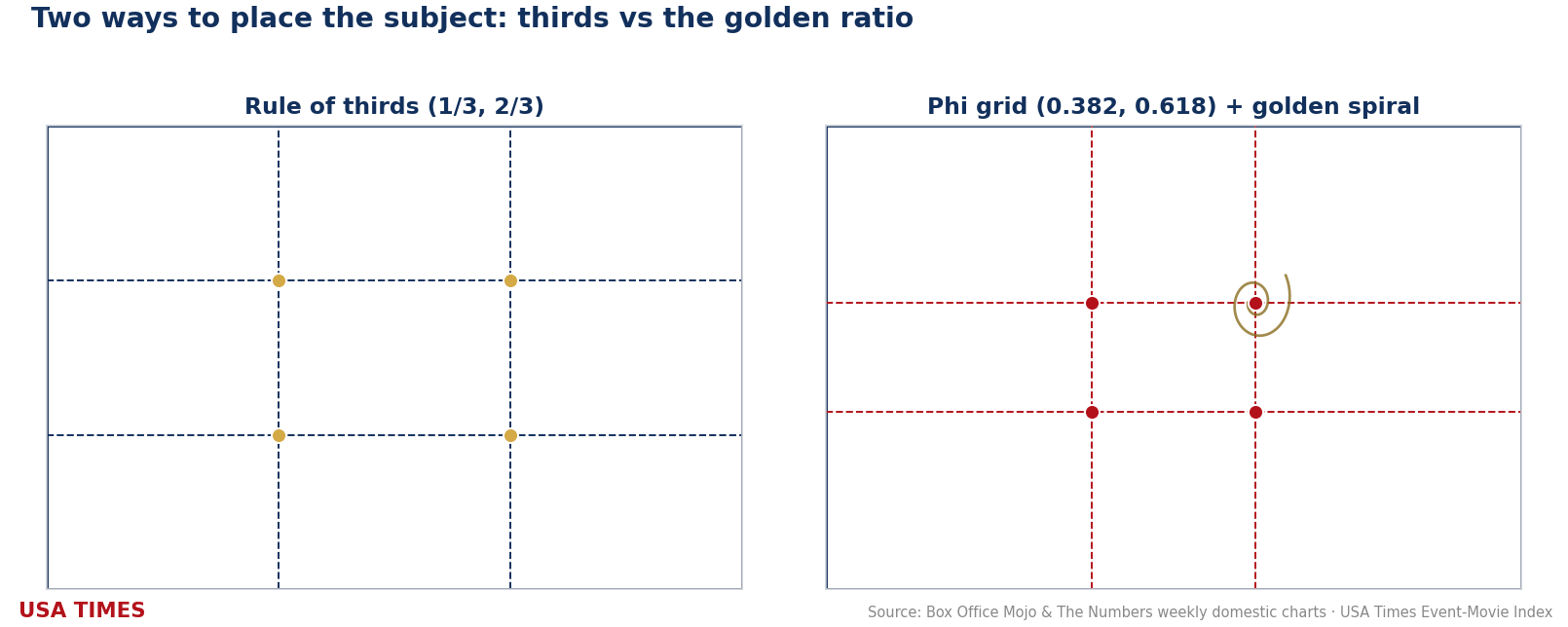
Filmmakers really do place their subjects on grids. The near-universal one is the rule of thirds: divide the frame into a 3×3 grid and put your points of interest where the lines cross. It is taught everywhere, built into camera viewfinders, and used constantly. The golden-ratio alternative — the phi grid — does almost the same thing, but slides the dividing lines slightly inward, to 0.382 and 0.618 of the way across instead of one-third and two-thirds. The two grids are close cousins; their sweet spots sit only a few percent apart, as the diagram shows.
Some cinematographers genuinely prefer the phi grid, arguing that its slightly tighter framing feels more natural for faces and gives a touch more room to the “looking” side of a portrait. That is a legitimate stylistic choice. But here is the honest part: because the phi points and the thirds points are so close, you can almost never tell from the finished image which grid, if either, the operator was thinking about. A shot that lands on a golden point also lands very near a thirds point. The overlay proves less than it appears to.
Batmandir · Founders A numbered seat at the table. S3 · The Founders Club — 161 seats per location. By invitation. Explore membership →The spiral that fits any shot
The golden spiral is where the analysis usually tips from craft into wishful thinking. A logarithmic spiral can be scaled, rotated, and flipped eight different ways, and dropped anywhere on a frame. Give an enthusiast that much freedom and they can make the spiral “explain” almost any well-composed image after the fact. The problem is not that the spiral never coincides with a good shot — it often does — but that it coincides with bad shots too, and with random photographs, if you are allowed to place it freely. A rule that fits everything predicts nothing.
None of this means composition is arbitrary. Great framing is real, learnable, and often mathematical in spirit — balance, leading lines, negative space, the tension between where a subject sits and where they look. Cinematographers like Roger Deakins or Gordon Willis composed with rigorous intent. The point is simply that their intent was rarely “hit 0.618,” and dressing their work in golden spirals tends to obscure the actual, teachable choices they made.
Use the grid, skip the magic
Our advice, for what a data desk’s advice on art is worth: treat the phi grid as one useful option alongside the rule of thirds — a slightly different set of sweet spots to try when a face feels awkwardly placed — and treat the golden spiral as a fun overlay rather than a law of nature. The proportion earns its keep in cinema not by governing the frame but by giving us clean numbers to reason with. On the screen, the golden ratio is a suggestion. In the box-office ledger, where we actually deploy it, it is a ruler.