Screenwriting has its own folklore about the golden ratio, and it is more defensible than the version cinematographers get sold. The claim goes like this: in a well-made film, the decisive turn — the moment the story pivots toward its ending — tends to land not at the exact middle but a little past it, around 0.618 of the way through. The “golden section” of the runtime. It is a lovely idea. Like most golden-ratio claims, it is part real observation and part after-the-fact tidying.
The beats that really exist
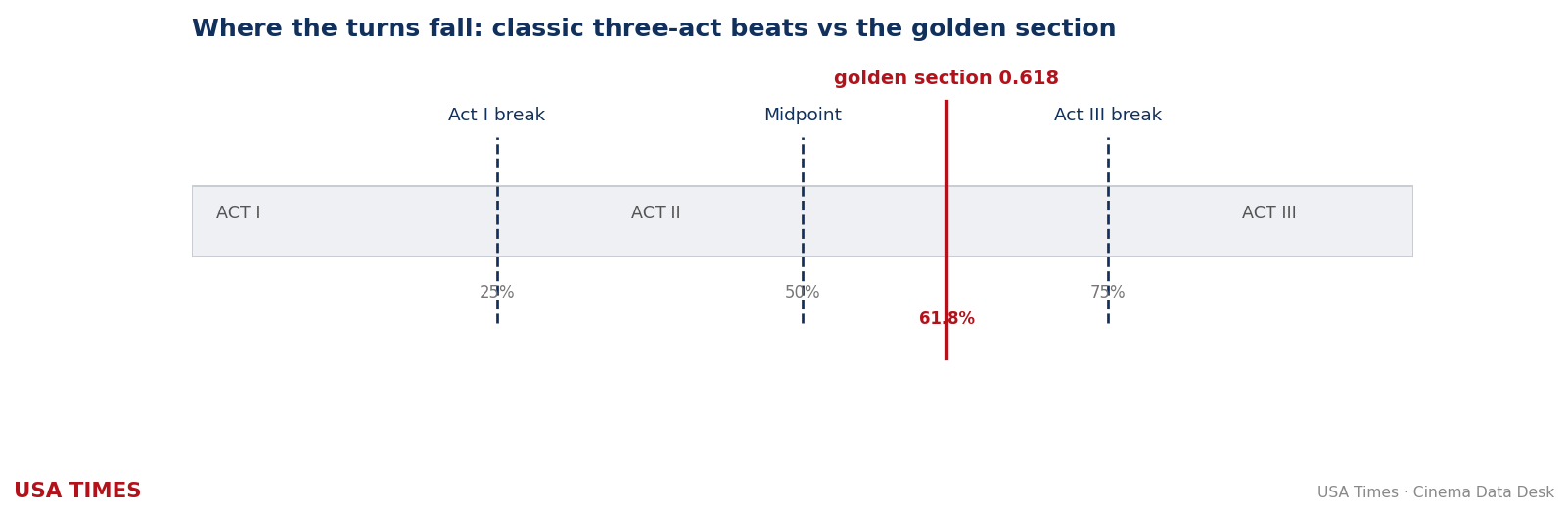
Mainstream storytelling genuinely does hit structural beats at fairly predictable places. In the standard three-act model taught in every screenwriting book, the first act break lands around a quarter of the way in, the midpoint sits at the halfway mark, and the second act break — the plunge into the finale — falls around the three-quarter point. Screenwriting guru Syd Field built an entire industry on this map, and it holds up remarkably well across thousands of studio films, because it reflects something real about how audiences sustain attention over two hours.
Notice where the golden section falls on that map: 0.618 sits between the midpoint and the act-three break, right in the churning heart of the second act — the region screenwriters often call “the long dark night,” where the hero’s plan collapses before the final push. That is a genuinely load-bearing stretch of most films. So the golden-section claim is not crazy: it points at a real zone of narrative tension. It just picks one precise number out of a broad, important region and dresses it up as a law.
Batmandir · Founders A numbered seat at the table. S3 · The Founders Club — 161 seats per location. By invitation. Explore membership →Why the precise number doesn’t hold
The trouble is that “the decisive turn” is not a single, objectively locatable frame. Different analysts, watching the same film, will place its true climax at different moments — the false victory, the lowest point, the final-battle kickoff. Give a motivated enthusiast that much latitude and a two-hour film offers a twenty-minute window in which something pivotal happens; 0.618 will almost always fall inside it. As with the golden spiral, a target that wide is easy to hit and proves little. Careful studies that pre-define the beat and measure it across many films find turning points scattered across the back half, clustering loosely around the three-quarter mark — not pinned to φ.
There is also a survivorship problem. The films people cite as golden-section masterpieces are, by definition, the ones that already feel perfectly paced. Nobody overlays the ratio on a clumsy movie to show how its badly placed climax violates φ. When you only test the theory on films it was chosen to fit, it will always seem to work.
The useful version of the idea
Strip away the numerology and a practical truth remains: great films tend to put their darkest, most decisive moment a little past the middle, not dead center, so the audience feels the story accelerate toward its end rather than sag. Whether that lands at 0.6, 0.618, or 0.7 is a matter of pace and genre, not a cosmic constant. A thriller may pivot early and sprint; a drama may linger. The “golden” instinct — delay the turn slightly past halfway — is sound craft. The decimal is decoration.
It is the same lesson the rest of our golden-ratio coverage keeps arriving at. The proportion is a wonderful lens for noticing patterns — here, that stories accelerate in their final third — and a poor one for legislating them. Use 0.618 to remember that the best turns come late, then trust your ear for pace over your calculator.