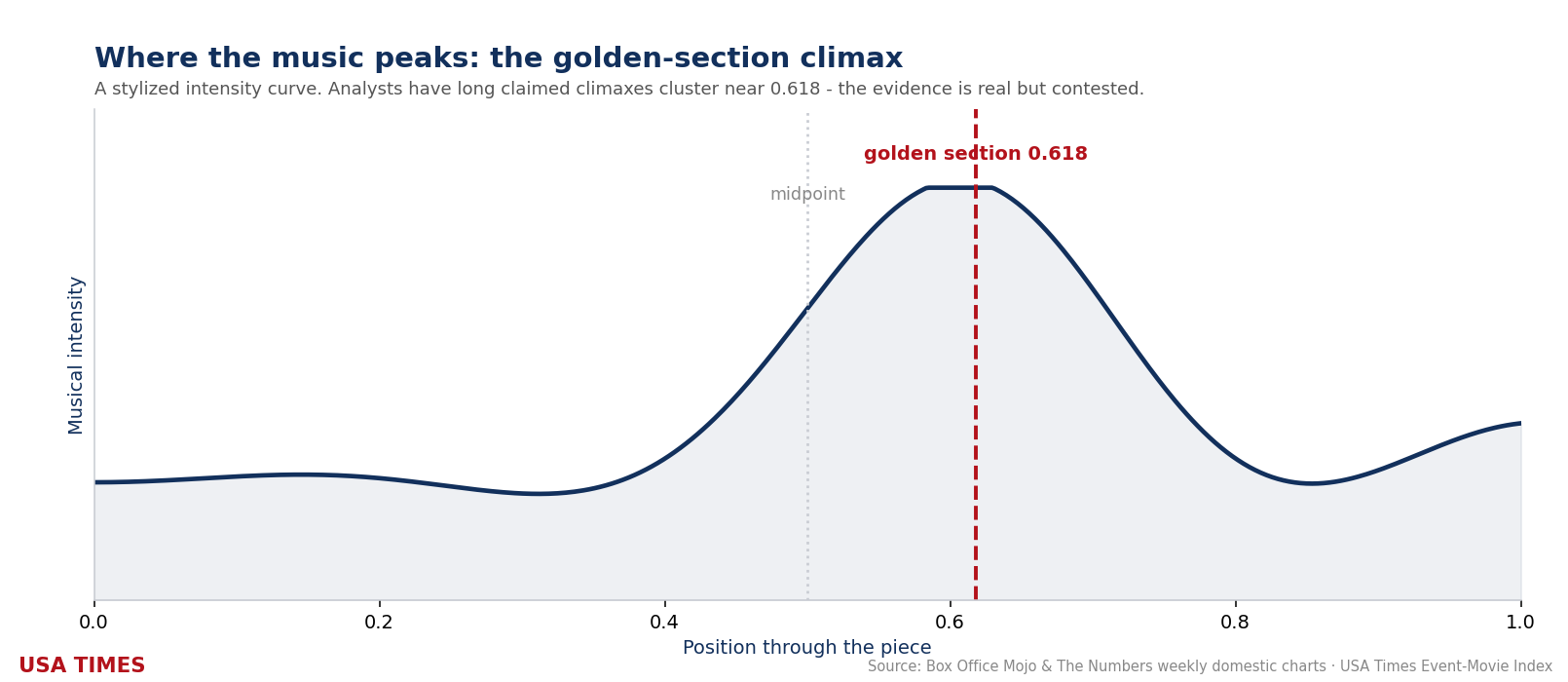
Of all the golden-ratio claims in the arts, the one about music has the strongest scholarly pedigree — and the most genuine controversy behind it. For decades, musicologists have argued that great composers place their climaxes not in the middle of a piece but a little past it, around the golden section of the total duration: roughly 0.618 of the way through. Film composers inherited that instinct, whether they name it or not, and it shapes how a score carries you toward a movie’s emotional peak.
The Bartók question
The scholarly heart of this debate is the composer Béla Bartók. In the 1970s the musicologist Ernő Lendvai argued that Bartók systematically built his forms on the golden ratio and Fibonacci numbers — that the loudest, most decisive moments of works like the Music for Strings, Percussion and Celesta land precisely at golden-section points. It is a genuinely striking analysis, and it convinced a generation of listeners. It has also been vigorously disputed: later scholars showed that Lendvai sometimes chose his measurement units and boundaries in ways that helped the numbers line up, and that Bartók himself never claimed to compose that way. The truth sits in a real but contested middle: the climaxes often do fall late, but whether they hit φ exactly, or Bartók intended it, remains unsettled.
What film composers actually do
Film music is a special case, because its shape is dictated by the movie, not by abstract form. A cue peaks when the scene peaks. And since films, as we have seen, tend to put their decisive turn a little past the middle, the music that underscores those turns naturally swells late too. So a golden-section climax in a score is often just an echo of the story’s structure — the composer following the picture, and the picture following the deep logic of three-act pacing. The ratio, if it appears, is downstream of the drama.
Batmandir · Guest Passes Step inside for a day. Guest passes from $161/day — brought in by a member. See guest passes →Great film composers — a John Williams building a theme across a trilogy, a Hans Zimmer stretching a single rising figure toward an overwhelming release, an Ennio Morricone withholding the full melody until exactly the right delayed moment — are masters of one thing above all: the timing of arrival. They know that a climax delivered too early exhausts the audience and one delivered too late loses them. The sweet spot they find by instinct sits, unsurprisingly, a bit past the middle. Whether that is 0.6 or 0.618 or 0.66 varies with every cue.
The honest verdict
So is the golden ratio hiding in film music? In the weak sense, yes: emotional peaks reliably arrive in the late-middle stretch the ratio points to, and that is a real, teachable principle of pacing. In the strong sense — that composers calculate 0.618 and place the downbeat there — almost certainly not, and the evidence marshaled for it tends to wobble under scrutiny, as the Bartók saga shows.
That is the same verdict this series keeps reaching, and it is not a dismissal. The golden ratio is a superb description of a real tendency — delay the peak past the middle — and a poor prescription. Composers earn their climaxes by ear, feeling the exact moment a scene can bear its biggest sound. The number is a nice way to notice that they tend to wait. It is not the reason they know when to strike.