If any film deserves its reputation as a golden-ratio touchstone, it is Alfred Hitchcock’s Vertigo (1958) — the story of a detective whose fear of heights and obsessive love spiral, literally and figuratively, out of control. Film students have laid golden spirals over its frames for generations. But Vertigo is the rare case where the spiral is not an overlay imposed after the fact. It is genuinely, deliberately in the movie. The catch is that it is there as a symbol, not as a governing geometry — and the difference is the whole point.
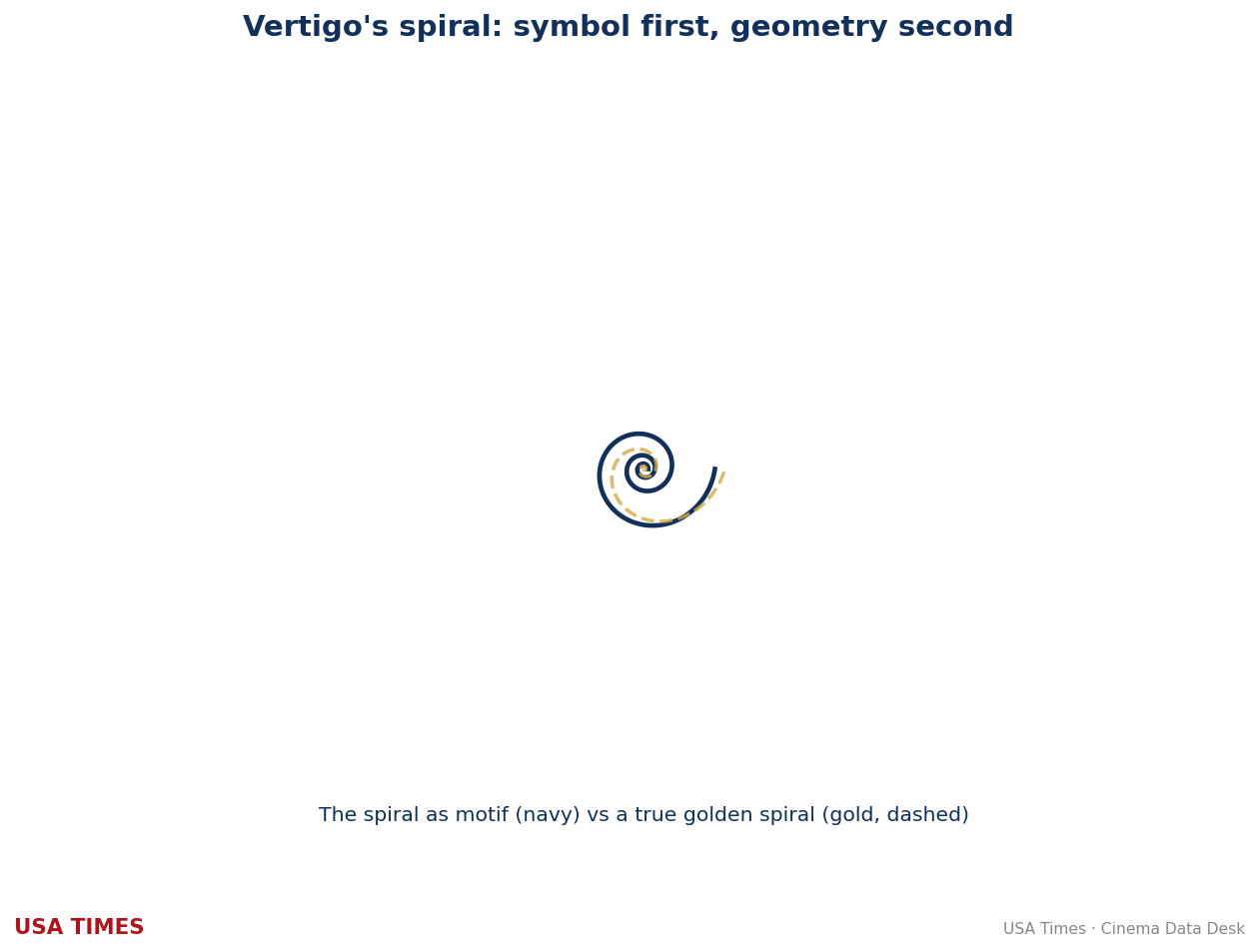
The spiral Hitchcock actually put on screen
The spiral runs through Vertigo as an explicit visual theme. It opens with a celebrated title sequence — designed by Saul Bass, with pioneering computer-drawn spiral animations by John Whitney — in which hypnotic spirals emerge from a staring eye. The motif returns everywhere: the tight spiral of Madeleine’s coiled hairstyle, the vertiginous curl of the mission staircase, the swirling nightmare montage. And the film’s most famous technical invention, the “dolly zoom” — tracking the camera back while zooming in, so the space seems to stretch and warp — is a spiral rendered as pure sensation. Hitchcock built the movie’s dread out of the shape of a coil closing in.
This is deliberate, authored symbolism, and it is superb. The spiral means something in Vertigo: obsession that circles ever tighter, a man drawn helplessly toward a fixed point, time and desire folding back on themselves. When a director chooses an image this consciously and threads it through every level of a film, that is craft of the highest order, and it deserves every bit of its acclaim.
Batmandir · Guest Passes Step inside for a day. Guest passes from $161/day — brought in by a member. See guest passes →But is it the golden spiral?
Here is the distinction that usually gets lost. A spiral motif is not the same as the golden ratio. There are many spirals in mathematics — the Archimedean spiral, the general logarithmic spiral, and the specific golden spiral whose radius grows by a factor of 1.618 every quarter turn. Whitney’s animated spirals were built from the mechanics of his home-made analog computer, not from φ. The staircase and the hair bun are simply coils. Nothing in the production record suggests Hitchcock or his collaborators calculated a golden growth rate; they wanted the feeling of a spiral, and any spiral delivers that.
So when an enthusiast overlays a precise golden spiral on a frame of Kim Novak and announces that Hitchcock “used the golden ratio,” they are conflating two true-but-separate things: that the film is about spirals (yes, gloriously) and that its compositions obey the golden proportion (no evidence, and easy to fake with a freely placed curve). Vertigo is the best possible illustration of the confusion, because it is the one film where the spiral is unmistakably intentional — which makes it tempting to credit the specific golden version it never actually needed.
Why the real story is better
The honest version of Vertigo’s genius is more impressive than the numerological one. Hitchcock did not solve an equation; he found a single, resonant image — the spiral — and made it carry a character’s entire psychology, from the title card to the camera lens to the shape of a woman’s hair. That is what great symbolic filmmaking looks like, and it needs no golden ratio to justify it. Reducing it to φ actually shrinks the achievement, trading a rich act of authorship for a tidy party trick.
The lesson generalizes. The golden ratio is often invoked precisely where a filmmaker has done something deliberate and powerful with shape or proportion — and then given credit for it, as if the number, rather than the artist, did the work. Vertigo earns its spirals the hard way: by meaning them. That is worth far more than hitting 1.618, and it is the difference between a film that merely looks balanced and one that will still make you dizzy seventy years on.