Mathematics is supposed to be un-cinematic — static, abstract, allergic to a close-up. And yet the movies keep coming back to it, because the real drama of math is human: obsession, genius, madness, and the terrible loneliness of seeing a pattern no one else can. A surprising number of these films reach, at some point, for the same character we have spent this series chasing: the golden ratio.
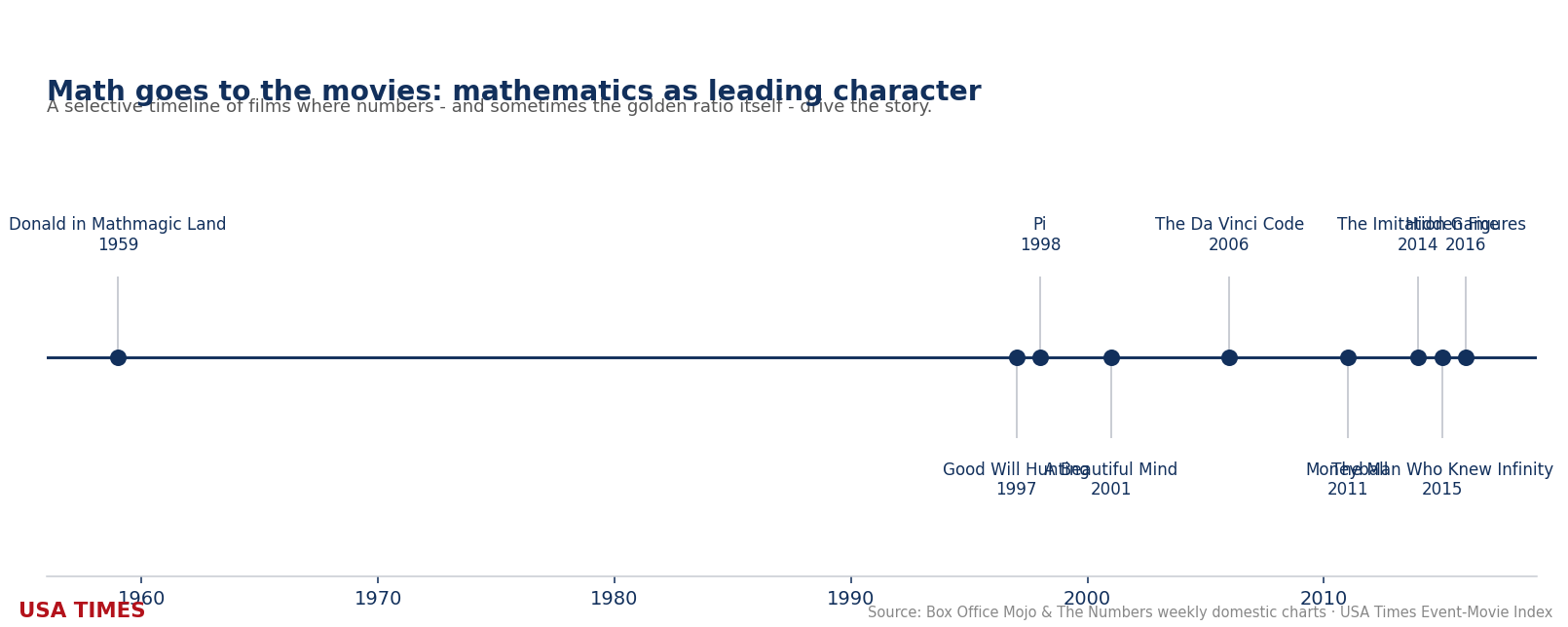
When Hollywood name-checks φ
Two films put the golden ratio front and center. The first, improbably, is a 1959 Disney short: Donald in Mathmagic Land, in which Donald Duck is walked through the “golden section” and Fibonacci numbers with genuine, if breathless, enthusiasm. For millions of schoolchildren it was the first and last time anyone made the ratio feel magical — and it is, tellingly, full of exactly the overclaims (the Parthenon, the “perfect” rectangle) that later scholars would deflate. The second is The Da Vinci Code (2006), where the plot literally hinges on the Fibonacci sequence and a professor lectures a classroom on how 1.618 supposedly governs everything from sunflowers to the human body. It is thrilling, and it is also a fairly complete catalog of golden-ratio myth — Hollywood repeating the legend it inherited.
Obsession as spectacle
The best math movie about pattern-hunting is Darren Aronofsky’s Pi (1998), a paranoid black-and-white nightmare about a number theorist convinced a single sequence unlocks the stock market and the name of God. Its spirals and its dread owe an obvious debt to Vertigo, and it understands something most math films miss: that the search for a hidden order can curdle into madness. Where Pi dramatizes obsession, A Beautiful Mind (2001) dramatizes its cost, turning John Nash’s game theory and schizophrenia into the same restless drive to see structure everywhere. Both films know the golden-ratio impulse intimately — the yearning to believe the universe is written in a clean proportion — and both treat it as seductive and dangerous.
Batmandir · Guest Passes Step inside for a day. Guest passes from $161/day — brought in by a member. See guest passes →Genius, decoded and humane
A gentler tradition treats mathematicians as heroes to be understood rather than pathologized. Good Will Hunting (1997) hides its prodigy in a janitor’s uniform; The Imitation Game (2014) turns Alan Turing’s codebreaking into wartime suspense; The Man Who Knew Infinity (2015) dramatizes Ramanujan’s almost mystical intuition; Hidden Figures (2016) reclaims the Black women whose calculations put Americans in orbit; and Moneyball (2011) smuggles statistics into a baseball crowd-pleaser. None of these lean on the golden ratio, and they are better for it — they find their drama in real problems and real people rather than in numerology.
That contrast is the quiet lesson of the whole subgenre. The films that invoke the golden ratio tend to use it as mystical shorthand — a signal that something cosmic and hidden is afoot — while the films that actually respect mathematics find their power in the human beings doing it. The ratio makes a great McGuffin and a poor protagonist.
Why we keep filming the number
The enduring appeal is emotional, not technical. A number on a blackboard is nothing; a person staring at that number, seeing a door where everyone else sees a wall, is everything. The golden ratio recurs in these movies for the same reason it recurs in design-blog folklore: it flatters our deepest wish, that beneath the mess of the world lies a single elegant proportion that explains it. The movies are honest enough, at their best, to show that the wish is as perilous as it is beautiful.
Which is roughly where this series has landed, too. We built an index on 1.618 because it is a clean, useful ruler — and we have spent nine articles resisting the temptation to treat it as a hidden key to beauty. The math movies dramatize both impulses at once: the rigor and the romance, the tool and the myth. Watch them for the humans. Enjoy the golden-ratio cameos. And keep one eyebrow raised whenever a professor points at a sunflower and says the universe is written in φ.