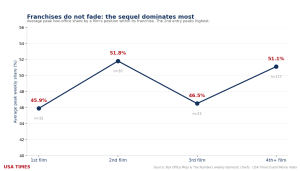
There is a piece of film-fan folk wisdom that turns out to be more than a hunch: the second film in a trilogy is often the best. The Empire Strikes Back. The Dark Knight. Spider-Man 2. Aliens. Toy Story 2. The list of middle chapters that outshine the films around them is long and distinguished — long enough that it demands an explanation. And the explanation, satisfyingly, rhymes with the golden ratio we have chased through this whole series.
The trilogy’s golden section
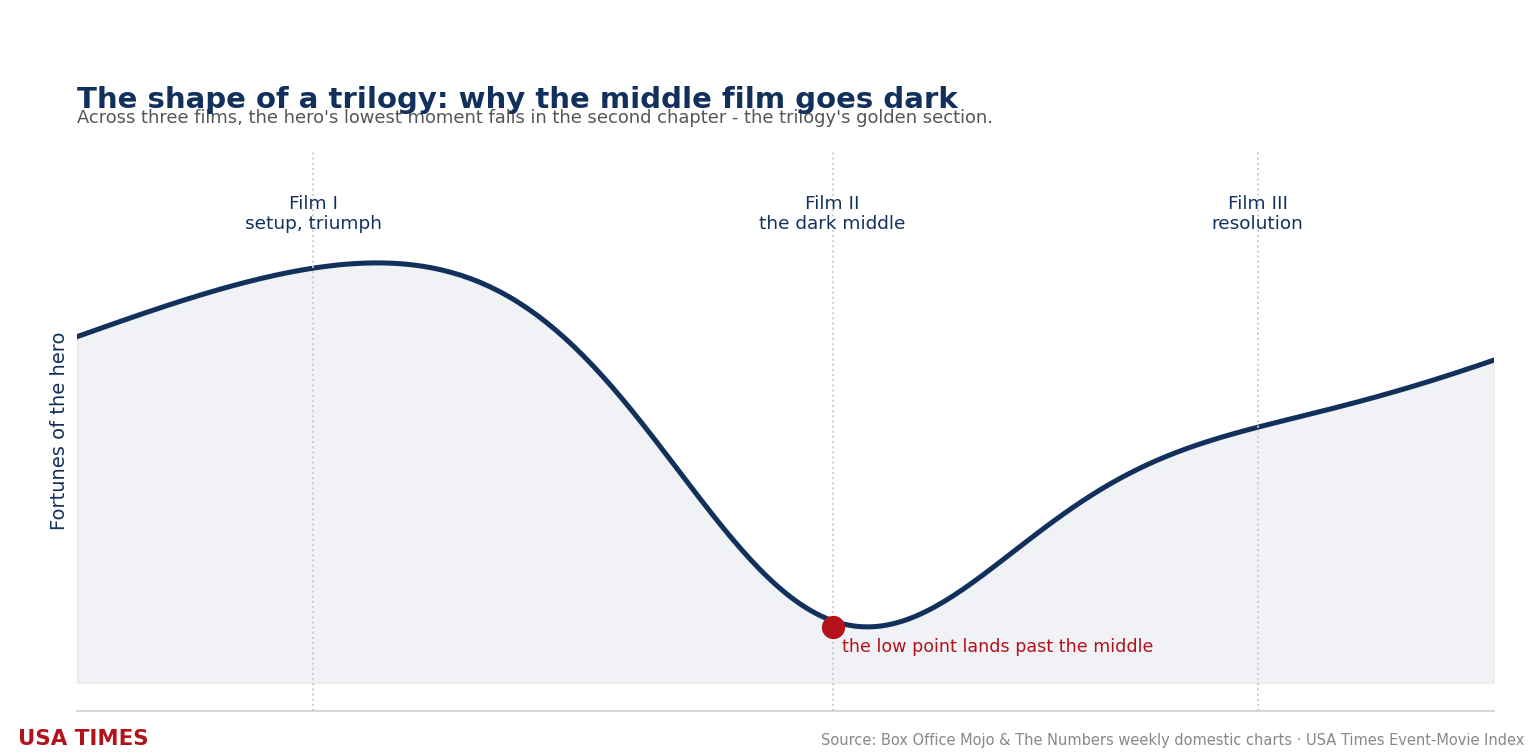
Think of a trilogy as a single enormous story stretched across three films. In the classic shape of any story, the hero’s darkest hour — the moment all seems lost, just before the final push — does not fall in the middle. It falls a little past the middle, around the golden section, at roughly 0.618 of the way through. Map that onto a trilogy and the darkest hour lands squarely in the second film. Han frozen in carbonite; Batman’s city turned against him; the colonists already dead when the Marines arrive. The middle chapter is where the overall trilogy hits its low point, and low points are where drama is richest.
That structural accident hands the second film all the best material. It inherits characters we already love — no time wasted on introductions — and it is freed from the obligation to wrap everything up, which so often forces third films into crowded, tidy finales. The middle chapter gets to do the two things audiences remember most: deepen the people and darken the stakes. It is, quite literally, the golden section of the saga.
Batmandir · The Circle Full access to theatres, museums & exhibitions. S2 · ongoing membership, without a Founder’s seat. Explore membership →The famous middles
| The beloved middle film | Year | Trilogy / series |
|---|---|---|
| The Empire Strikes Back | 1980 | Star Wars |
| The Dark Knight | 2008 | Batman |
| Spider-Man 2 | 2004 | Raimi Spider-Man |
| Aliens | 1986 | Alien |
| Toy Story 2 | 1999 | Toy Story |
| Mad Max 2: The Road Warrior | 1981 | Mad Max |
| X2: X-Men United | 2003 | X-Men |
| Captain America: The Winter Soldier | 2014 | Captain America |
The honest counter-argument
We should resist turning a nice pattern into an iron law, because plenty of middle films are forgettable and plenty of trilogies peak elsewhere. The Godfather Part II is a middle film revered as a match for the first — but it was only ever conceived as a two-part story, not a trilogy’s pivot. Some franchises front-load their best chapter and coast; others build to a genuine third-film climax. And there is a selection effect at work: we remember The Empire Strikes Back and forget the dozens of second films that were simply cash-grab placeholders. The “middle film is best” rule survives partly because its failures are unmemorable.
Still, the structural logic is real, and it is the same logic that governs the golden section of a single screenplay, just scaled up. Delay the darkest turn slightly past the midpoint and the story gains momentum toward its end; in a trilogy, that darkest turn simply has a whole film to itself. Whether it lands at exactly 0.618 of the saga is beside the point — as always with the golden ratio, the decimal is decoration and the instinct is what matters. The instinct here is sound: put your heroes through the fire in the middle, and the middle becomes the part nobody forgets.