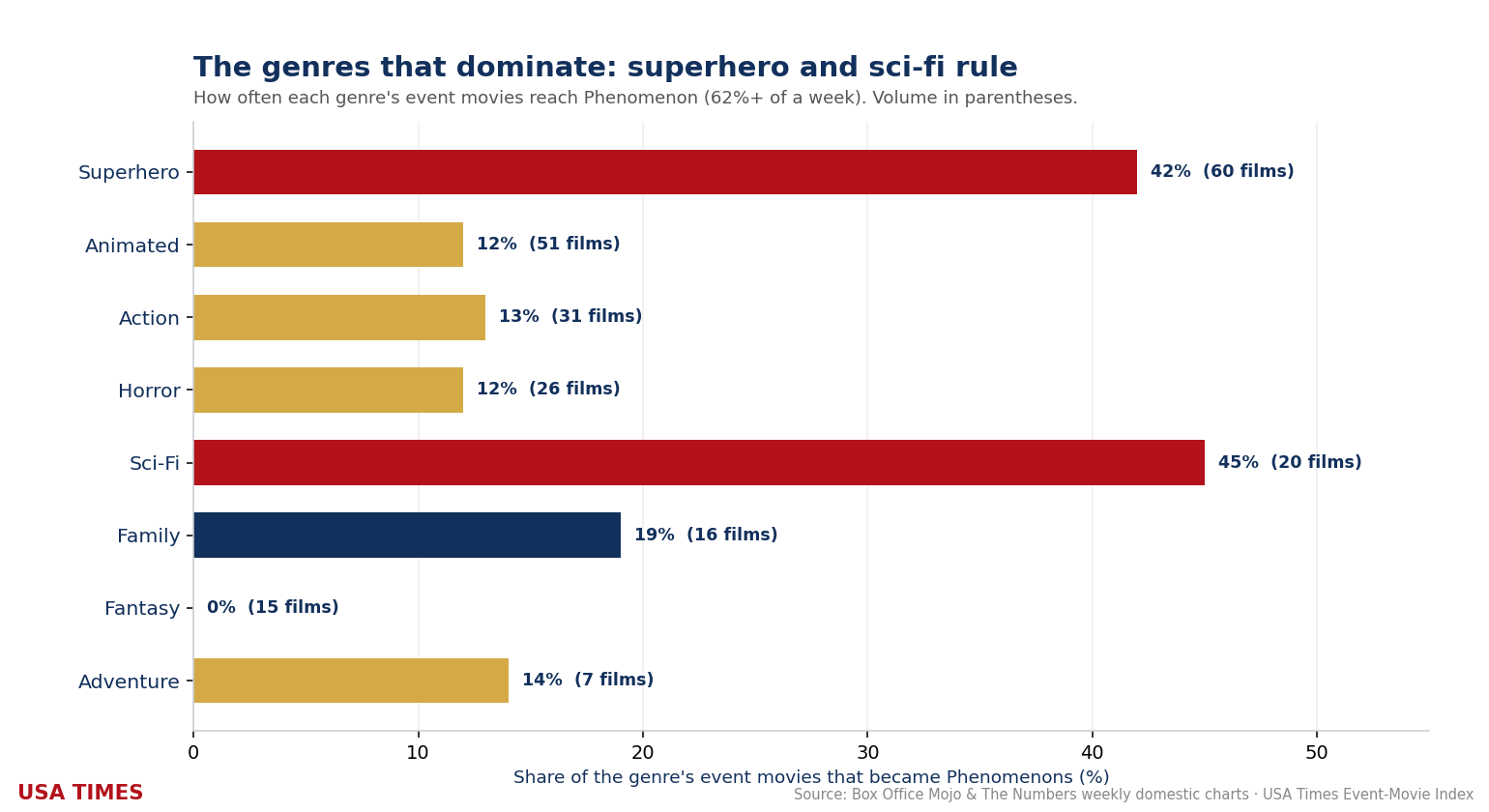
Not all blockbusters dominate alike. Sort twenty years of star movies by genre and a clear hierarchy emerges — not of how many films each genre produces, but of how completely they take over when they arrive. Two genres tower above the rest, one wins on volume without ever quite conquering, and one dominates constantly but only ever in miniature. The golden-ratio tiers turn a vague sense of “what kinds of movies are big” into a precise ranking.
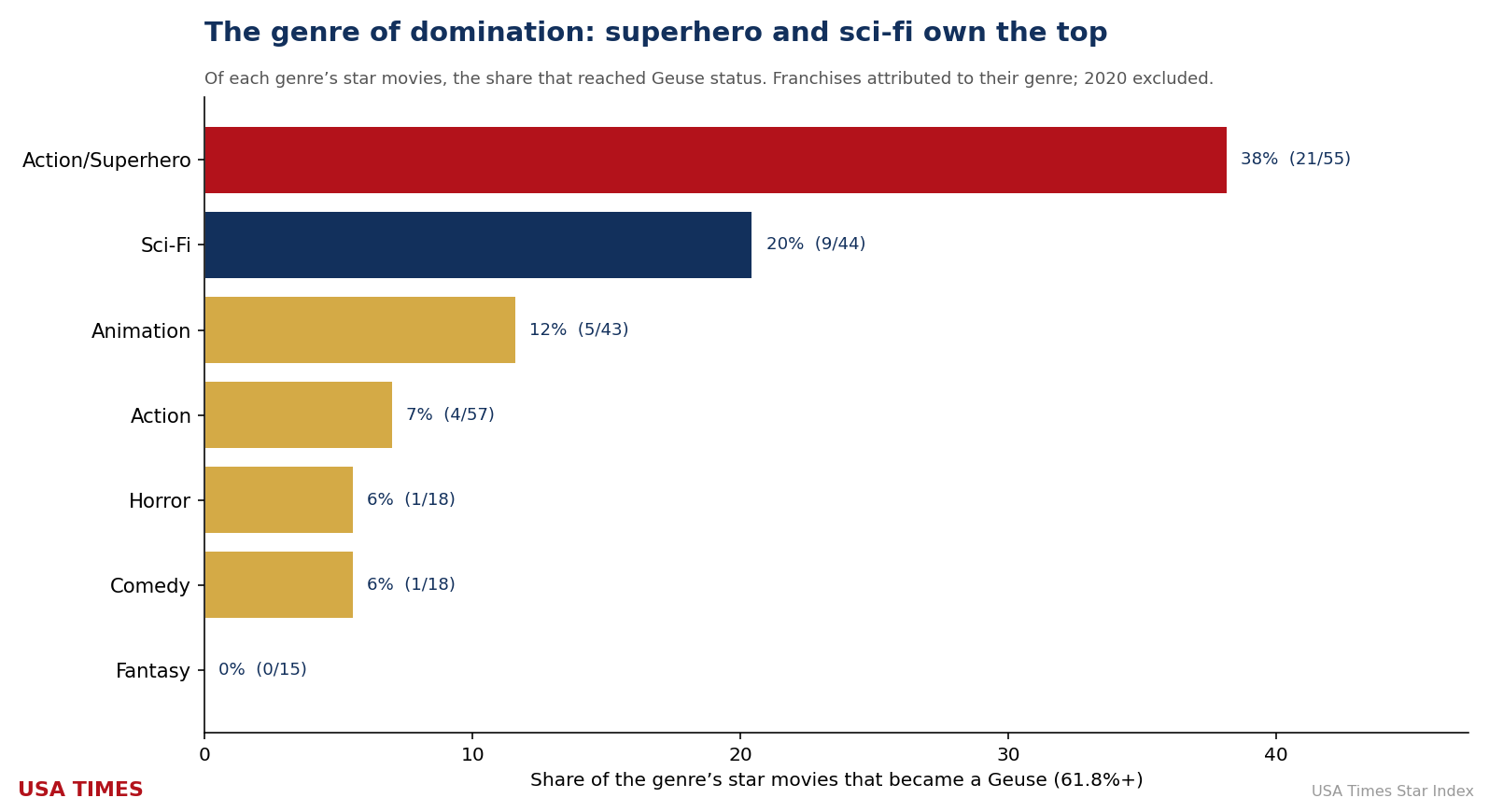
Superheroes and sci-fi: the total-domination genres
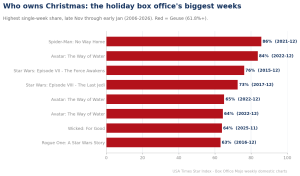
The two genres most likely to produce a Geuse — a film seizing 61.8% or more of a week — are superhero and science fiction. More than four in ten of their star movies reach that peak, roughly triple the rate of any other genre. It is easy to see why: these are the four-quadrant spectacles studios build entire calendars around, released into deliberately cleared weekends with IMAX screens and marketing budgets to match. When a Marvel entry or an Avatar or a new Star Wars opens, it is engineered not just to win but to erase — and it usually does.
| Genre | Mini-geuse movies | Geuses | Geuse rate | Avg peak |
|---|---|---|---|---|
| Superhero | 60 | 25 | 42% | 58.1% |
| Animated | 51 | 6 | 12% | 43.2% |
| Action | 31 | 4 | 13% | 45.7% |
| Horror | 26 | 3 | 12% | 40.1% |
| Sci-Fi | 20 | 9 | 45% | 57.4% |
| Family | 16 | 3 | 19% | 48.2% |
| Fantasy | 15 | 0 | 0% | 44.2% |
| Adventure | 7 | 1 | 14% | 48.5% |
Animation: the volume champion that rarely conquers
Animation is the fascinating counter-case. It produces a huge number of star movies — second only to superheroes — because family films draw reliably and open wide. But they rarely reach total domination; only about one in eight animated star movies becomes a Geuse. The reason is structural: family audiences spread their business across a longer window and multiple weekends rather than stampeding on opening night, and animated films frequently share the market with counter-programming aimed at adults. Animation wins broadly and steadily. It just seldom eclipses the whole sky at once.
Batmandir · Guest Passes Step inside for a day. Guest passes from $161/day — brought in by a member. See guest passes →Horror’s modest, relentless domination
Horror is the genre of small, frequent victories. It generates a steady stream of star movies — the Conjurings, the Its, the micro-budget shockers — but posts the lowest average peak share of any major genre, and reaches Geuse only rarely. Horror’s magic trick, as we documented in our efficiency analysis, is economic rather than dominant: it owns weeks cheaply, returning enormous multiples on tiny budgets, without ever needing to swallow the market whole. And fantasy is the surprise at the bottom — a genre of Harry Potter and Hobbit giants that, in our window, never once reached the Geuse line, always strong but never total.
The usual caveats apply: this counts the films we could confidently classify, genre labels are fuzzy at the edges, and share measures domination in a moment rather than money over a run. But the hierarchy is robust and it explains a lot about how studios behave. If your goal is to own a weekend completely, you make a superhero film or a sci-fi epic and clear the runway. If your goal is dependable profit, you make animation or cheap horror and let the math work. Genre, it turns out, is not just a marketing category. It is a strategy for how completely you intend to take over.