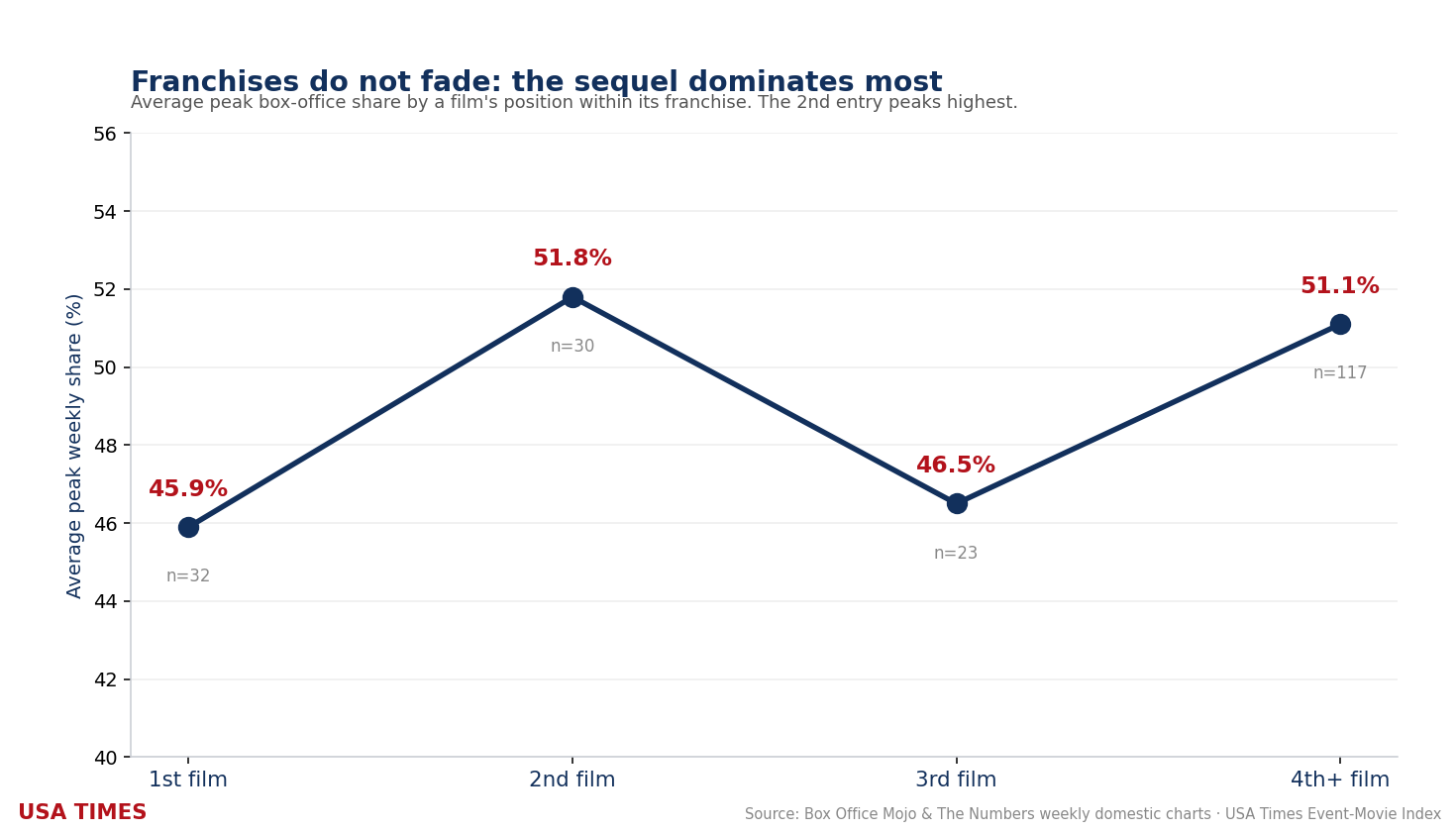
The received wisdom about franchises is a story of decline: a fresh original, a bigger sequel, then diminishing returns as the well runs dry and audiences drift away. It is a tidy narrative, and the box-office domination data mostly refuses to confirm it. Measured by how completely each entry seizes its opening week, franchises do not fade. If anything, they get stronger before they plateau — and the single most dominant chapter is usually the second one.
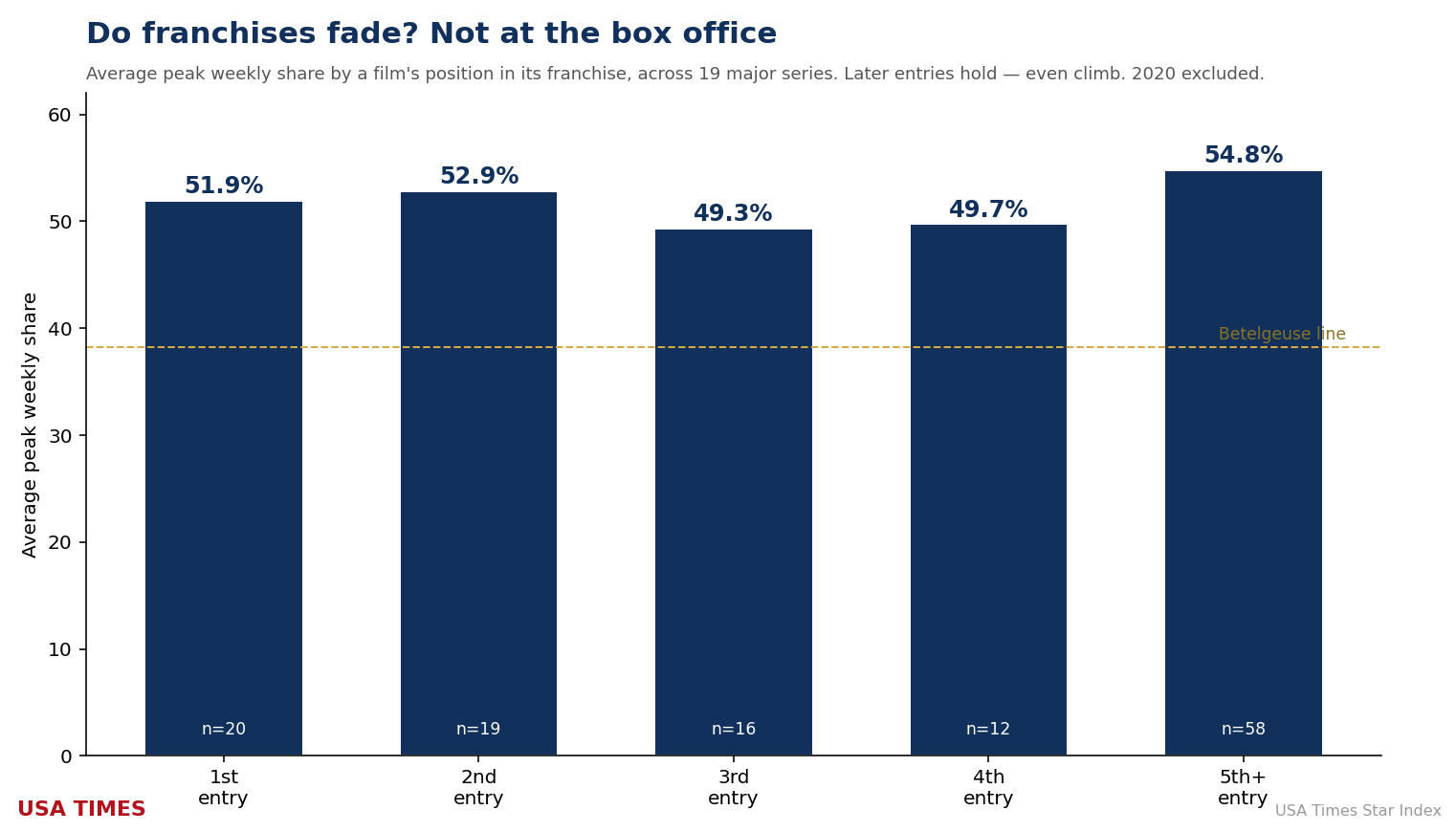
The sequel surge
Line up every franchise entry by its position in the series and average how completely each seized its week. The first film averages a 45.9% peak share. The second jumps to 51.8% — a clear step up, not down. This is the “sequel surge” we glimpsed earlier in this series, now visible as a curve: the follow-up arrives with a built-in audience the original had to earn from scratch, and it converts that head start into a bigger, more dominant opening. The second film doesn’t coast on the first. It out-dominates it.
| Position in franchise | Films | Average peak share |
|---|---|---|
| 1st film (franchise starter) | 32 | 45.9% |
| 2nd film | 30 | 51.8% |
| 3rd film | 23 | 46.5% |
| 4th film and beyond | 117 | 51.1% |
The survivorship trick
The most counterintuitive number is the last one: films that are the fourth entry or later in their franchise average a higher peak share than the originals that spawned them. Does this mean franchises never tire? Not quite — and here honesty matters. This is survivorship bias in its purest form. A franchise only reaches a fourth or fifth entry if the earlier ones were hits; the weak series die at entry two and never pollute the “4th+” bucket. So the deep-franchise films look strong not because sequels are immortal, but because we are only ever measuring the winners that earned the right to keep going. The Marvel Cinematic Universe alone fills much of that column.
Batmandir · The Circle Full access to theatres, museums & exhibitions. S2 · ongoing membership, without a Founder’s seat. Explore membership →Read correctly, then, the curve tells two true things at once. Among all franchises, the second film really does tend to dominate hardest — a genuine sequel surge driven by inherited awareness. And among the franchises that survive to a fourth chapter, domination stays high — not because fatigue is a myth, but because we have quietly filtered out every series that fatigue already killed. The decline is real; it just happens to the franchises that never made it into this chart.
For studios, the lesson is the one they have already internalized, sometimes to a fault: the safest bet in the business is the second film of a franchise that worked. It carries the least risk and, on this evidence, the most domination. The danger is the corollary — that an industry which has learned this too well keeps greenlighting sequels four, five, and six deep, chasing the survivors’ numbers while forgetting how many series quietly expired to produce them. The curve rewards persistence. It does not promise it.