Look closely at our masthead. The four stars aren’t decoration — they’re a small act of mathematical obsession. Each one is almost exactly 1.618 times the size of the last, and each is trimmed by a different power of the same famous number. Here is the story of that number, the shape we hid it in, and why a newsroom that spends its days arguing about the price of a sandwich also cares about the golden ratio.
Most people never look at a logo twice. That is more or less the job of a logo: to be recognized, not studied. Ours is built to reward the second look — and almost nobody takes it. So consider this our confession. The stars in the USA Times wordmark are not there to look patriotic, or at least not only for that. They are a puzzle. And the puzzle has a single answer, a number that has been exact for about 2,300 years.
The tell: four stars, one ratio
Set the four stars side by side, smallest to largest, and measure them. The second is bigger than the first, the third bigger than the second, the fourth bigger still — nothing surprising there. What is surprising is how much bigger. Every star has an area about 1.618 times the area of the one before it. Not roughly bigger. Not “a bit” bigger. The same multiplier, four times running.
Batmandir · The Circle Full access to theatres, museums & exhibitions. S2 · ongoing membership, without a Founder’s seat. Explore membership →That multiplier has a name: φ (phi), the golden ratio. Its exact value is (1 + √5) / 2, which works out to 1.6180339887… and never stops or repeats. If you have met one irrational celebrity, it was probably π. φ is the other one — quieter, older in some tellings, and a lot more opinionated about how things should be shaped.
A number with a very long head start
Euclid wrote φ down around 300 BC, though he did not call it golden. In the Elements he describes cutting a line “in extreme and mean ratio”: divide a line so that the whole is to the larger part exactly as the larger part is to the smaller. Solve that little sentence and φ falls out. Two millennia later the astronomer Johannes Kepler called it one of geometry’s two great treasures — the other being the Pythagorean theorem — and said the first was a measure of gold, the second a precious jewel.
The number is also stubbornly self-referential, which is what makes it fun to build with. Square it and you just add one: φ² = φ + 1. Take its reciprocal and you subtract one: 1/φ = φ − 1 = 0.618… It is the same digits after the decimal point, shifted around like a card trick. And if you divide each number in Leonardo Fibonacci’s famous sequence — 1, 1, 2, 3, 5, 8, 13, 21… — by the one before it, the answers march straight toward φ and never leave.
We should be honest, because being honest about numbers is the whole brand: a lot of what you have heard about the golden ratio is oversold. The Parthenon, the Mona Lisa, your credit card — many of those “φ is everywhere” claims are wishful measuring after the fact. Where φ genuinely shows up is in growth: the spiral of seeds in a sunflower, the scales of a pinecone, the leaves spacing themselves around a stem so none shadows the next. φ is nature’s answer to “how do I keep getting bigger without repeating myself?” That felt like a good thing for a newspaper to borrow.
Why a star? Because the star is the ratio
Here is the part that made a five-pointed star the only honest choice. Draw a regular pentagram — a five-pointed star in one stroke — and every straight line inside it is cut by the others into golden sections. The long diagonal of a regular pentagon divided by its side is exactly φ. The star is not decorated with the golden ratio; it is the golden ratio, wearing five points. The ancient Pythagoreans knew this well enough to use the pentagram as their secret handshake. So when we went looking for a shape to carry the number, we did not have to add anything. The star already had it.
The golden ladder
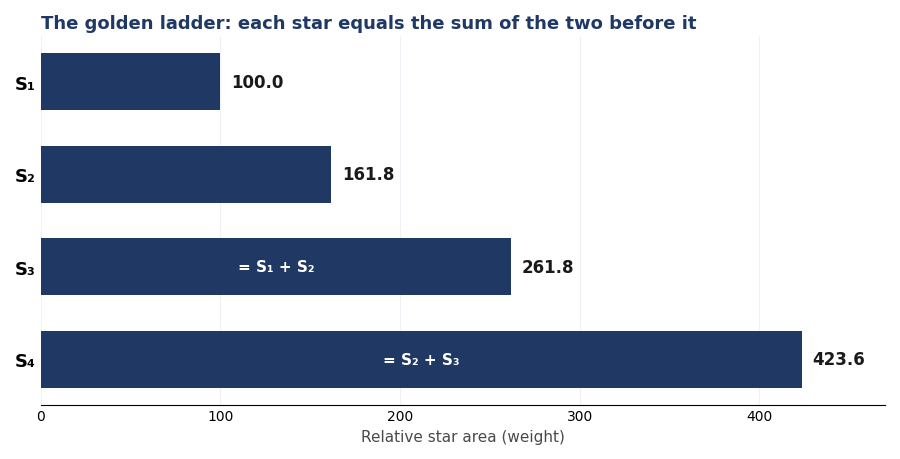
Give the smallest of the four working stars a size of 100 — call it weight, since we sized them by area, not height. The next weighs about 161.8. The next, 261.8. The largest, 423.6. Each is φ times the last, exactly as designed. But there is a second pattern hiding in those numbers, and it is prettier than the first.
Add the first two: 100 + 161.8 = 261.8, which is the third. Add the second and third: 161.8 + 261.8 = 423.6, which is the fourth. Each star is the sum of the two before it. That is not a coincidence layered on top of the golden ratio — it is the golden ratio. Remember φ² = φ + 1? Multiply that identity up the ladder and you get exactly this rule, the same one Fibonacci’s rabbits obey. Our stars grow like a living thing that has read the textbook.
And then we cut them
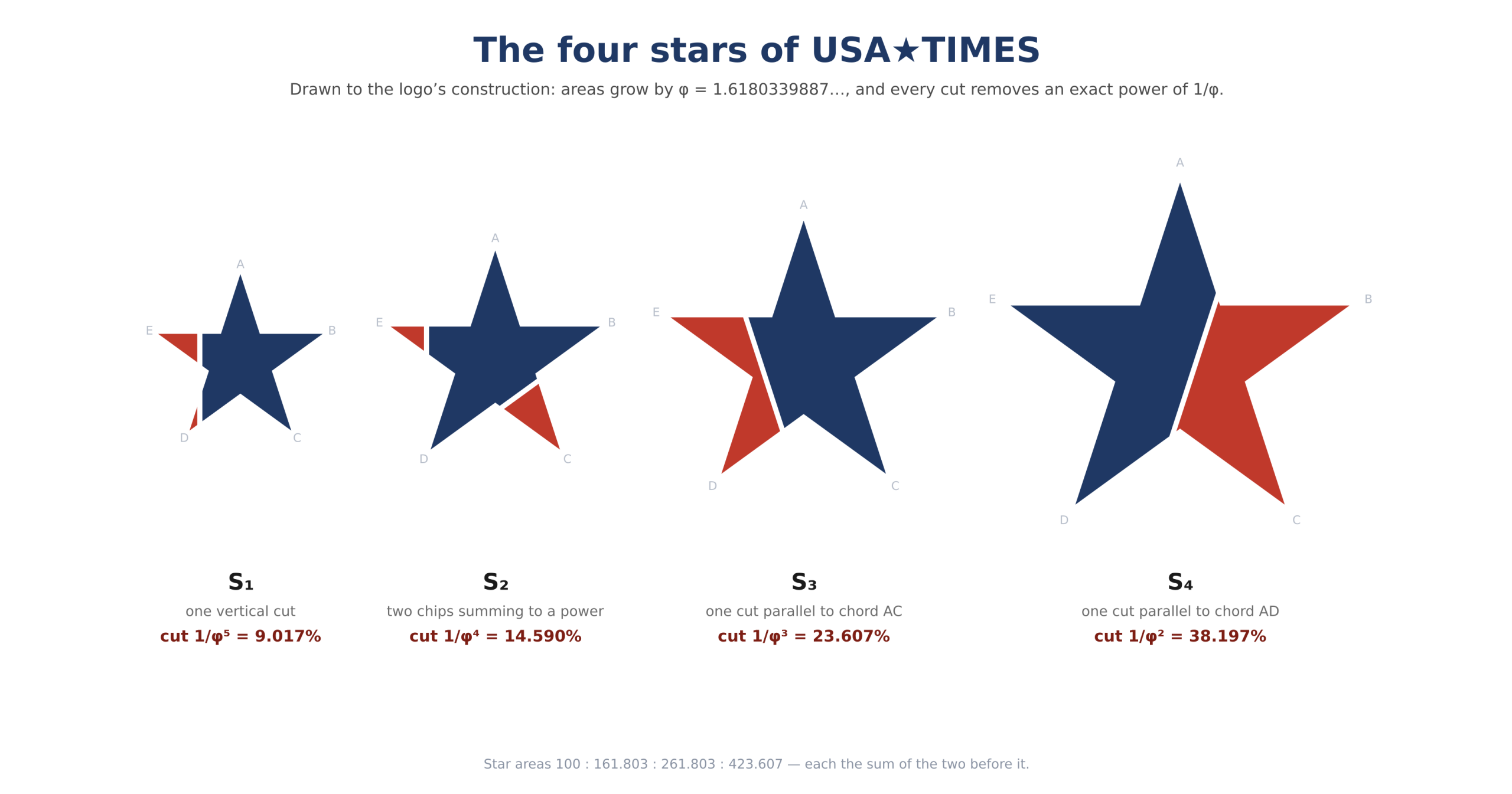
Growing them in a golden sequence would have been enough for most logos. It was not enough for us. Each of the four stars is also trimmed — a single clean slice removes a sliver — and the size of each cut is, once again, a power of the golden ratio.
The smallest star loses about 9.0% of its area, which is 1/φ⁵. The next loses 14.6% (1/φ⁴). The next, 23.6% (1/φ³). The largest gives up 38.2% (1/φ²). We solved each cut line by computer so the shaded piece removed is not “about” those fractions — it is those fractions, to as many decimal places as you care to check.
Now watch the cuts do the same trick the sizes did. 9.0% + 14.6% = 23.6%. 14.6% + 23.6% = 38.2%. The amounts we removed form their own golden ladder, nested inside the ladder of the stars themselves. And the two biggest fractions, 1/φ and 1/φ² — that is 61.8% and 38.2% — add up to exactly 1, the whole star. It is turtles, or rather golden ratios, all the way down.
1/φ = φ − 1 = 0.618… · φ² = φ + 1 = 2.618…
Star sizes: 100 → 161.8 → 261.8 → 423.6 (each = sum of the two before)
Star cuts: 1/φ⁵ ≈ 9.0% · 1/φ⁴ ≈ 14.6% · 1/φ³ ≈ 23.6% · 1/φ² ≈ 38.2%
1/φ + 1/φ² = 0.618 + 0.382 = 1
The star before the first star
There is one more number in our working file, and it sits quietly below the rest: 61.8. It is the seed the whole sequence grows out of — because 61.8 × φ = 100, our smallest visible star. In the golden world you can step backward as easily as forward; 1/φ is just φ with the decimal shifted. Our stars don’t begin at 100 so much as they continue from 61.8, which continues from 38.2, which continues from 23.6, downward forever in the same ratio. A logo, it turns out, is a fine place to keep an infinite sequence and show only the middle of it.
Nothing is wasted: the ledger of the stars
Here is the part that still makes us grin. Look at what each cut leaves behind — and at the piece that falls away. Cut the largest star, S₄, by 1/φ²: the piece you sliced off weighs 161.803 — exactly S₂, and the star that remains weighs 261.803 — exactly S₃. Cut S₃ by 1/φ³: the offcut weighs 61.803 — exactly S₀, the seed star, and what remains weighs 200 — exactly two copies of S₁. Every scrap on the cutting-room floor is another member of the family. The logo recycles itself.
| Star | Full weight | Cut | Cut weight | Remaining | Which is… |
|---|---|---|---|---|---|
| S0 | 61.803 | — | — | 61.803 | the seed — untouched |
| S1 | 100 | 1/φ⁵ = 9.017% | 9.017 | 90.983 | — |
| S2 | 161.803 | 1/φ⁴ = 14.590% | 23.607 | 138.197 | what remains = 2·S₁ − S₀ |
| S3 | 261.803 | 1/φ³ = 23.607% | 61.803 = S₀ | 200 = 2·S₁ | the offcut is S₀; the rest is two S₁s |
| S4 | 423.607 | 1/φ² = 38.197% | 161.803 = S₂ | 261.803 = S₃ | the offcut is S₂; the rest is S₃ |
None of this is a coincidence, and the proof fits in one line. The remainder of S₃ is φ² − 1/φ (in units of S₁). But φ² = φ + 1, and 1/φ = φ − 1. Subtract: (φ + 1) − (φ − 1) = 2. Exactly two. Not 1.99, not “about double” — the golden ratio’s own algebra guarantees that when you trim the third star by 1/φ³, you are left holding precisely two of the first. That is the whole character of φ in one gesture: cut it anywhere along its own powers, and the pieces snap back into the sequence like they never left.
Why put math no one asked for into a logo?
Fair question. The honest answer is that it is the same instinct that runs the rest of this newsroom. We spend our days deciding whether a $9.85 delivery sandwich should really be $8.45, adding up fees other people would rather you not add up, and refusing to round when the exact number is more interesting. A masthead built on a constant that has been precise since Euclid is a small, private promise to ourselves: the math checks out, even in the places you are not looking. Especially in the places you are not looking.
And, sure — partly we just think it is cool. There is a particular joy in hiding a 2,300-year-old idea in plain sight at the top of a website and waiting to see who notices. If you have read this far, you noticed. Welcome to the nerd section; we made it for you.
So the next time you glance at the USA Times logo, know that the four stars are quietly doing arithmetic — growing by φ, cut by φ, adding themselves up like a sequence that refuses to end. They have been the whole time. You were just not supposed to look twice.
How we did the math. Star “weights” are relative areas measured in pixels and normalized so the smallest working star = 100; the near-constant weight-per-pixel across all stars confirms the sizes scale as area, not height. The golden ratio φ is computed as (1 + √5) / 2 to ten decimal places. Figures are drawn to the logo’s actual construction: S₁ takes one vertical cut, S₂ takes two chips (1/φ⁷ by a vertical cut plus 1/φ⁴−1/φ⁷ by a bisector cut), S₃ one cut parallel to chord A–C, S₄ one cut parallel to chord A–D. Each cut offset was solved by binary search so the removed area equals its exact fraction — our solved S₁ cut lands at x = −0.468653, matching the construction diagram to six decimal places. Figures by the USA Times Data Desk. This one’s just for fun — no restaurants were harmed.
Related from the USA Times Data Desk
- The Billion-Dollar Club, Ranked: Every Star Movie That Crossed the Line
- Box Office Tracker: "Minions & Monsters" mantém o 1º lugar e "Michael" ultrapassa US$ 371 mi sem alarde
- One Movie, Most of the Money: How Total Box-Office Domination Went From Exception to Norm (2006–2026)
- Box Office Tracker: "Minions & Monsters" Holds No. 1, "Michael" Quietly Crosses $371M
- Box-office coverage index · the Star Index methodology