Every definition draws a line, and every line creates heartbreak on the wrong side of it. The USA Times Star Index sets the bar for a “star movie” at 26.18% of a full week’s U.S. box office — the golden-ratio threshold where a film stops being one of several hits and becomes the story of the week. These films got agonizingly close, led their week at the top of the chart, and still fell short. The almost-events.
Missed by a rounding error
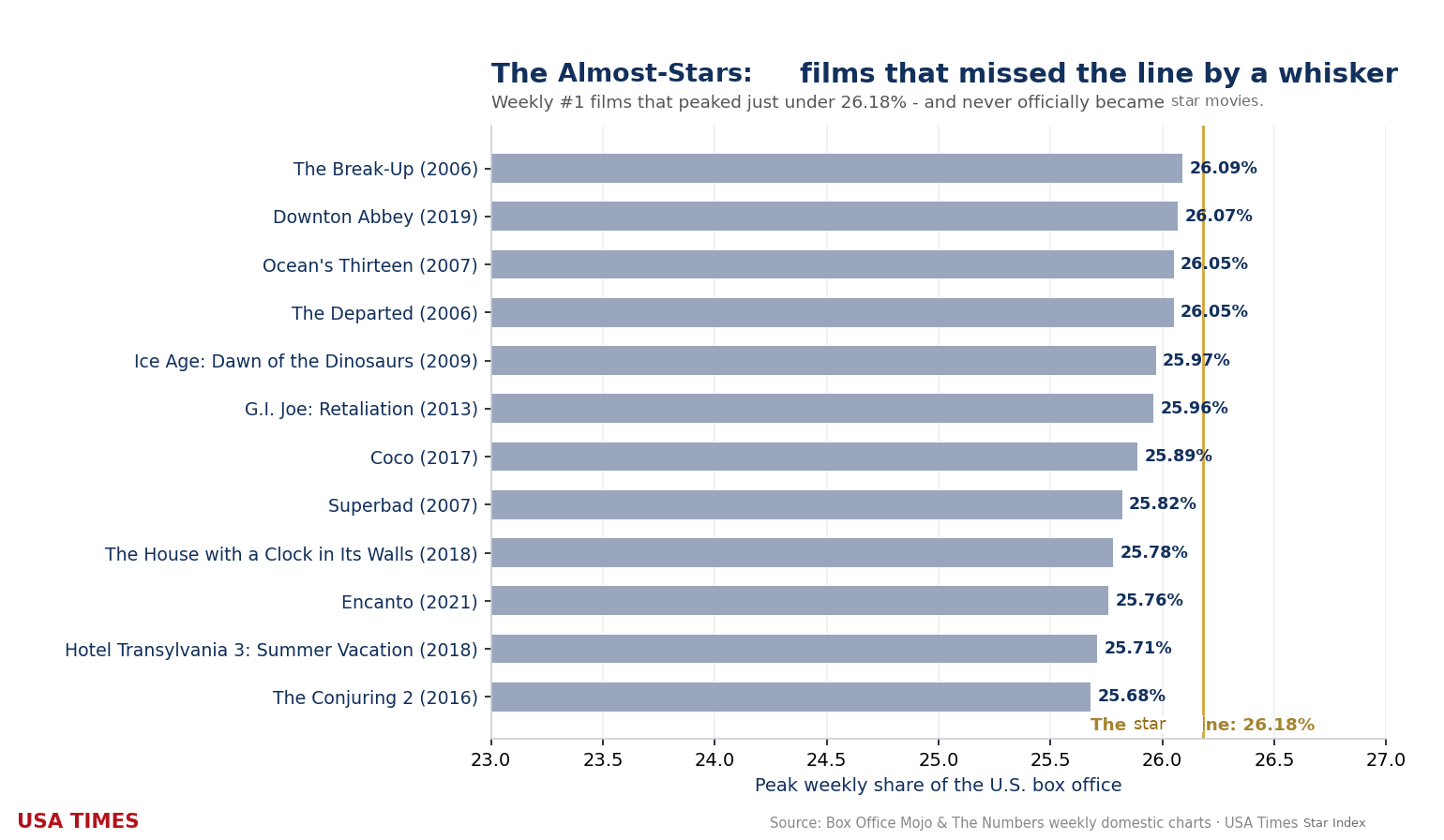
The closest miss of all is The Break-Up (2006), which peaked at 26.09% — short of the line by just 0.09 of a percentage point. It was the number-one film in America that week. It simply didn’t own enough of the week to qualify. A few thousand tickets in either direction and it would be in the index instead of this footnote.
| # | Film | Year | Peak share | Short by |
|---|---|---|---|---|
| 1 | The Break-Up | 2006 | 26.09% | −0.09 pts |
| 2 | Downton Abbey | 2019 | 26.07% | −0.11 pts |
| 3 | Ocean’s Thirteen | 2007 | 26.05% | −0.13 pts |
| 4 | The Departed | 2006 | 26.05% | −0.13 pts |
| 5 | Ice Age: Dawn of the Dinosaurs | 2009 | 25.97% | −0.21 pts |
| 6 | G.I. Joe: Retaliation | 2013 | 25.96% | −0.22 pts |
| 7 | Coco | 2017 | 25.89% | −0.29 pts |
| 8 | Superbad | 2007 | 25.82% | −0.36 pts |
| 9 | The House with a Clock in Its Walls | 2018 | 25.78% | −0.40 pts |
| 10 | Encanto | 2021 | 25.76% | −0.42 pts |
Is 26.18% arbitrary? Every threshold is, a little. We chose it because it is the golden ratio — 1 minus 0.618 — the same proportion that governs the rest of the index, which gives the whole system one consistent piece of math instead of a pile of round numbers. But these near-misses are a useful reminder that a label is a line, and lines are unforgiving by design. These films were, for one week, the biggest thing in American theaters. History just won’t quite call them events.
Batmandir · The Circle Full access to theatres, museums & exhibitions. S2 · ongoing membership, without a Founder’s seat. Explore membership →The tyranny of a bright line
Every threshold is, in some sense, arbitrary at its exact edge, and the almost-events are the price any clean definition pays for its clarity. The USA Times index draws its lowest line at 26.18% of a week’s box office — a figure chosen because it is the golden ratio’s fingerprint, not because anything magical happens to a film at 26.2% that does not happen at 26.0%. And yet the line has to fall somewhere, and wherever it falls, some films will land agonizingly on the wrong side of it. These are the movies that led their week, drew real crowds, and by any casual description were “the number one movie in America” — and still, by the index’s reckoning, did not quite become star movies. They are the footnotes a definition creates simply by existing.
There is something clarifying about studying the near-misses, because they force a reckoning with what the threshold actually means. A film at 26.0% and a film at 26.3% are, in every meaningful sense, identical achievements; the index treats one as an event and the other as an also-ran. This is not a flaw to be apologized for but a feature to be understood: a category is a line, and lines are unforgiving by design. The value of a strict threshold is precisely that it does not bend to sentiment; the cost is that it occasionally exiles a film that, by a few thousand tickets, deserved to be inside.
Why the line is where it is
It is fair to ask whether 26.18% is the right place to draw the boundary, and the honest answer is that any threshold in its neighborhood would tell substantially the same story. We chose the golden-ratio figure for a specific reason: it produces a set of clean, principled, non-arbitrary cut points — 26.18%, 38.2%, 61.8% — that divide domination into three intuitive bands without our having to hand-pick round numbers that happened to flatter the data. A threshold of 25% or 30% would reclassify a handful of films at the margin but would not change any conclusion the index reaches about concentration, seasonality, or the rise of the monopoly week. The near-misses shift; the big picture does not.
The consolation of the almost-event
For the films themselves, missing the line by a whisker is no disgrace — quite the opposite. To lead the entire American box office for a week, even at 25-point-something percent, is an achievement the overwhelming majority of films released in any year never come close to. The almost-events were, for seven days, the biggest thing in American theaters; they simply arrived in a week crowded enough, or opened at a scale modest enough, that they could not quite clear the bar. Many of them went on to earn more over their full runs than films that did cross the line in a softer week. The index measures domination in a moment, not merit over a lifetime, and the almost-events are a useful reminder that a single week’s share, for all its precision, is only one way of keeping score.
The almost-events also serve a quiet methodological purpose: they are the proof that the threshold is being applied honestly. An index that quietly nudged borderline films across the line to make its lists more interesting would be worthless, and the existence of a documented set of near-misses — films left out by a fraction of a point — is the evidence that no such nudging occurs. Every film either cleared 26.18% or it did not, and the ones that did not, however narrowly, stay out. That discipline is what makes the films that did cross the line worth taking seriously. A category only means something if its boundary is real, and the almost-events are the boundary made visible.
And that, finally, is why the almost-events deserve their own accounting rather than silent omission: they are the shadow cast by every bright line, the necessary companions of any honest threshold, and a standing reminder that a film can be, for one week, the biggest thing in America and still fall a whisker short of history.