We have spent this series poking at golden-ratio claims about cinema — the frame, the spiral, the screenplay, the score, the poster — and reaching, over and over, the same two-part verdict: the proportion is a wonderful lens for noticing patterns and a poor tool for legislating them. It is worth stepping back and asking the bigger question head-on. Why does the golden ratio get credited for so much art it demonstrably did not govern? And how should an honest reader tell the real cases from the wishful ones?
A century of moving the goalposts
The modern golden-ratio craze is younger than people assume. The number itself is ancient — Euclid described it — but the idea that it is the secret of beauty was largely popularized in the 19th century, and much of the “evidence” assembled since has the same flaw. Analysts start with a masterpiece they already love, then hunt for a division, a rectangle, or a spiral that happens to land near 1.618, choosing the measurement boundaries that cooperate. Do that with enough freedom and you can find φ in a cereal box. The famous claims about the Parthenon, the Mona Lisa, and the nautilus shell have all been substantially deflated by careful measurement: the fit is loose, cherry-picked, or simply absent.
Psychology delivers the cleanest blow. For more than a century, researchers have asked people to pick their favorite rectangle, and the golden one wins only weakly and inconsistently — preferences are broad, culturally variable, and easily nudged by context. If the golden rectangle were objectively, universally most beautiful, a century of experiments would have found it by now. They have not.
Batmandir · Founders A numbered seat at the table. S3 · The Founders Club — 161 seats per location. By invitation. Explore membership →The tell: does the spiral fit, or was it fitted?
Here is a practical test you can apply to any golden-ratio claim about a film. Ask: was the overlay predicted, or was it fitted? A real pattern is specified in advance — “the climax will fall at 0.618, measured from these fixed endpoints” — and then checked. A fake one is drawn afterward, with the freedom to scale, rotate, flip, and reposition the spiral until it grazes something. Almost every viral golden-ratio movie graphic is the second kind. Once you notice the degrees of freedom being quietly used, the magic evaporates.
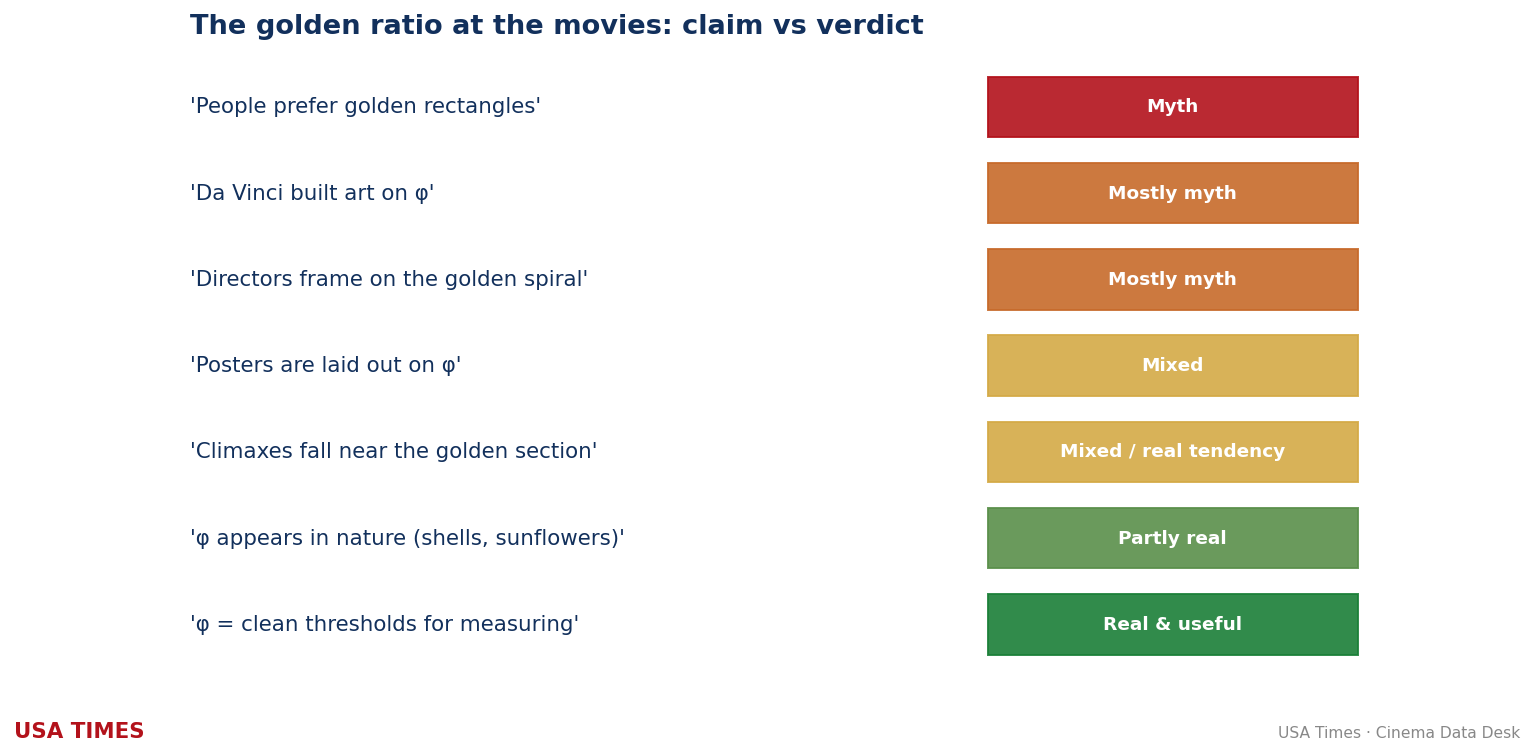
The chart above sorts the common claims by how they survive that test. “People prefer golden rectangles” and “the old masters engineered their art on φ” are essentially myths. “Directors compose on the golden spiral” is mostly myth with occasional deliberate exceptions like Vertigo’s spiral motif. “Climaxes fall near the golden section” reflects a real tendency — stories do peak late — wrapped in a spurious decimal. And φ’s genuine appearances in nature, in the spiral packing of sunflower seeds, are real but have nothing to do with beauty; they fall out of efficient growth, not aesthetics.
Where the number earns its keep
None of this makes the golden ratio useless — and it would be hypocritical for a publication that built an entire box-office index on 1.618 to say so. The distinction is what the number is for. As a claimed law of beauty, φ is overhyped and largely unfalsifiable. As a measurement convention, it is genuinely valuable: it hands you clean, principled, non-arbitrary thresholds. When we split box-office domination at 26.18%, 38.2%, and 61.8%, we are not claiming those shares are beautiful. We are using a fixed, defensible ruler so that our tiers aren’t just round numbers we picked to flatter a story.
That is the reconciliation this series has been building toward. Love the golden ratio for what it truly is: an elegant piece of mathematics, a fine lens for appreciating balance, and an excellent yardstick for measuring the world. Just be suspicious the moment someone tells you it caused a great film’s beauty — and ask them whether they predicted the spiral, or drew it once they already knew where to look.