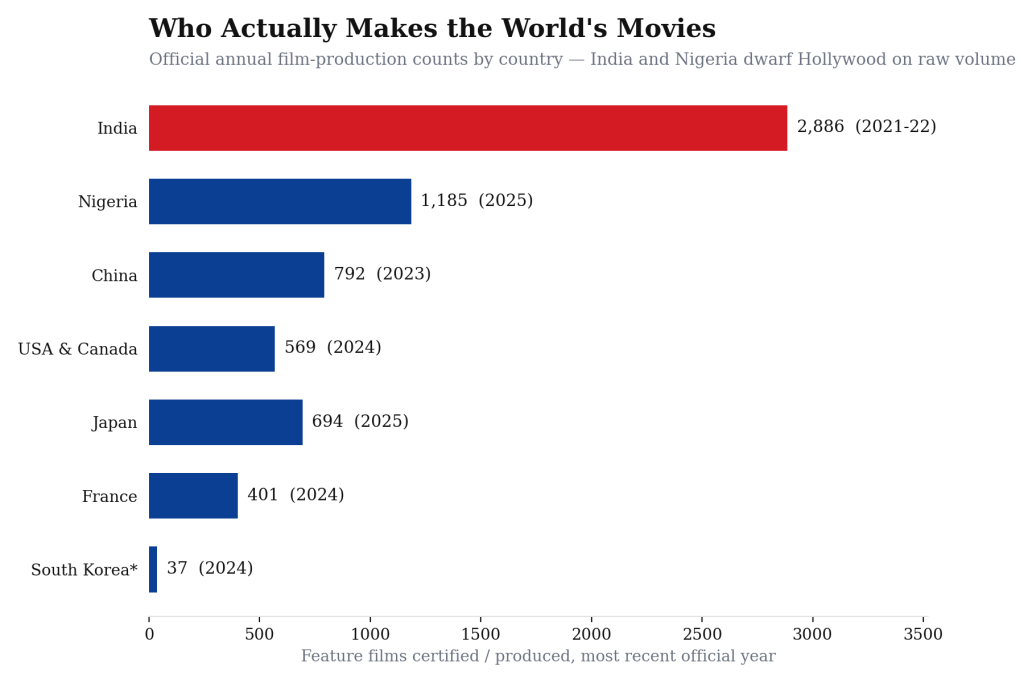
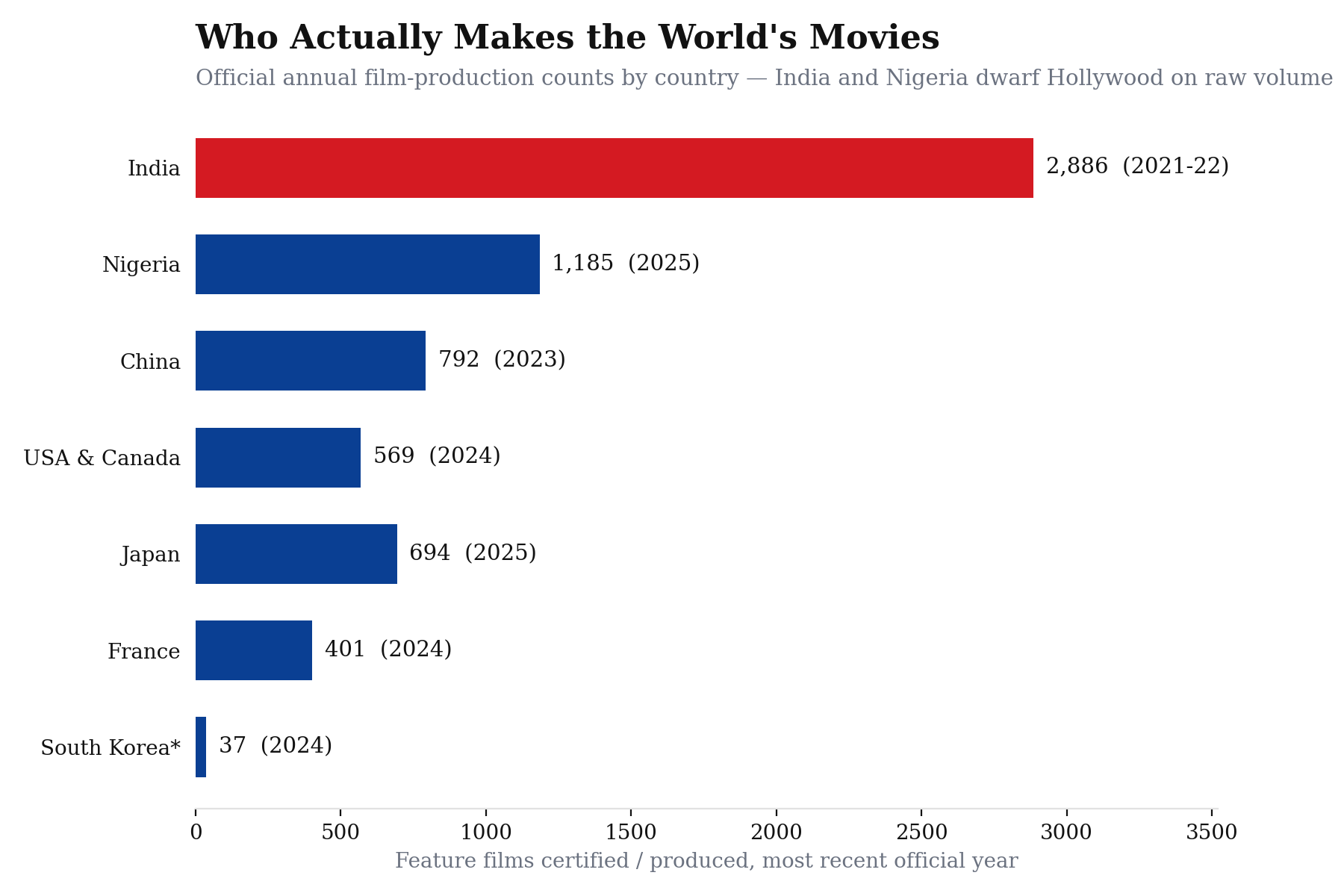
Ask most Americans which country makes the most movies and the reflex answer is the United States. It isn’t close. By official government counts, India certified 2,886 feature films in the most recent reporting year, Nigeria’s regulator classified 1,185, and China put out 792 — all comfortably ahead of the roughly 569 titles that hit U.S. and Canadian theaters in 2024. Hollywood dominates global box-office revenue. It does not dominate global film production, and the gap between those two facts is one of the more persistent misreadings of the industry.
Volume and revenue are different games
India’s film industry isn’t one industry at all — it’s several, running in parallel. Hindi-language Bollywood gets the international attention, but Telugu, Tamil, Kannada, Malayalam, Marathi and Bengali cinema each certify hundreds of films a year through India’s Central Board of Film Certification, and the combined total dwarfs any single national output elsewhere in the world. Nigeria’s Nollywood runs on a different model entirely: lower budgets, faster turnaround, and distribution built for home video and streaming as much as theaters, with the National Film and Video Censors Board reporting steady growth in films classified — 1,088 in 2024, 1,185 in 2025.
Hollywood runs on the opposite model: fewer films, vastly larger budgets, and a distribution and marketing machine built to extract maximum revenue from each release worldwide. The result is a strange asymmetry. The U.S. and Canada produced roughly a fifth as many films as India last year, yet North America still pulled in the single largest regional share of global box-office revenue. Volume and revenue, in this business, are almost unrelated variables.
Batmandir · Guest Passes Step inside for a day. Guest passes from $161/day — brought in by a member. See guest passes →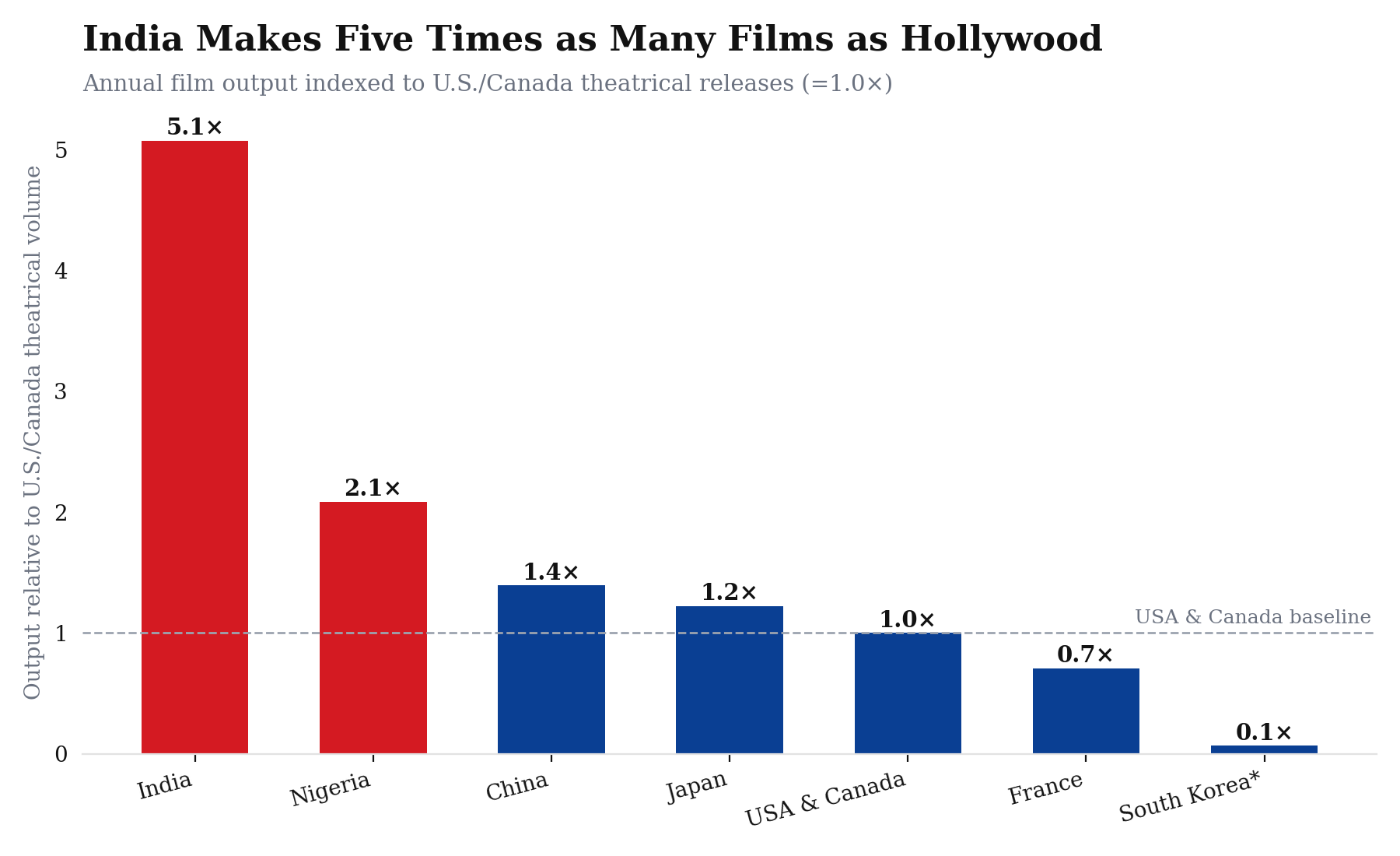
A note on comparing apples to very different apples
We want to be upfront about a real limitation in this comparison: every country counts “a film” differently. India’s CBFC certification covers every theatrical-bound feature across all its language industries. Nigeria’s NFVCB figure covers films classified for release, which increasingly means streaming and home video rather than cinemas. The France and Japan figures come from national funding and trade bodies that count films receiving formal production credit, not just theatrical releases. And the U.S./Canada number, sourced from The Numbers’ theatrical release calendar, counts only titles that actually opened in a cinema — it excludes the enormous volume of direct-to-streaming and direct-to-video U.S. production that never gets a theatrical certification at all.
None of that changes the headline: even the most theater-narrow read of India and Nigeria’s output still leaves them well ahead of the U.S. on raw film count. It just means the honest takeaway isn’t “India makes five times as many movies as America” as a precise multiplier — it’s that the world’s largest film industries by volume have never been the ones Americans picture first, and that’s been true for well over a decade.
Where the rest of the world sits
Japan certified around 694 films in the most recent year tracked, roughly on par with China and ahead of the U.S./Canada theatrical count. France, whose CNC has tracked production data since the 1940s, put out 401 — a figure that has held remarkably steady even as streaming reshaped how those films reach audiences. South Korea is the outlier worth flagging: the country’s five major studios released only 35 to 37 wide theatrical titles a year in 2023 and 2024, and are planning just 10 to 14 commercial releases in 2025 — a contraction the Korean Film Council has described in stark terms, even as Korean films that do get released are winning a larger share of their home box office than in years past.
That divergence — fewer films, but each one performing better — is worth watching. It suggests an industry consolidating around bigger bets rather than one simply shrinking, and it’s the same tension playing out globally: as production costs and marketing budgets climb, the calculation between making more films and making fewer, better-marketed ones is shifting almost everywhere except the two markets built on sheer volume.
The arithmetic behind the gap
The cleanest way to understand why volume and revenue point in opposite directions is to stop thinking about films and start thinking about revenue per film. A wide North American release is engineered to earn from a ticket base where admission prices run several times what they do in India or Nigeria, and then to earn again from international distribution, premium-format surcharges, home entertainment, and licensing deals negotiated territory by territory. A Nollywood feature, by design, earns modest revenue from a domestic audience paying modest prices, and it makes that model work by keeping budgets and schedules compressed to a fraction of what a studio release requires. Both are rational businesses. They are simply optimizing different variables, and a film count only registers the one that Hollywood has deliberately chosen not to compete on.
That framing also explains why the ranking is so stable year to year. Production volume tracks the cost of making a film and the size of the domestic audience willing to watch it; box-office share tracks the price of a ticket and the reach of a distribution network. Neither variable moves quickly. Short of a structural shock — a pandemic, a strike, a collapse in exhibition — countries do not swap places on either list, which is why the “India makes more films than Hollywood” fact has been true for decades without ever quite entering the American conventional wisdom.
How the volume leaders got there
India’s lead is not a recent development or a statistical artifact. It is the product of a country with more than a dozen commercially viable language markets, each with its own stars, studios, distribution networks and audience expectations, all certifying films through a single national board. A Telugu release and a Malayalam release are not competing for the same audience in any meaningful sense; they are parallel industries that happen to share a regulator. Count them together, as the certification data necessarily does, and the total was always going to exceed any country organized around one dominant language market.
Nigeria arrived at its position by a different route. Nollywood grew out of a direct-to-video boom in the early 1990s, built on cheap tape duplication and informal distribution rather than cinema infrastructure, and that origin still shapes the industry’s economics. The format has since migrated from videotape to discs to streaming, but the underlying logic — fast production, low fixed costs, distribution that does not depend on owning screens — carried over intact. The steady climb in films classified is less a sudden surge than the visible surface of a production system that was already operating at volume before anyone outside Nigeria was counting.
Screens are the constraint the film count hides
A production figure says nothing about whether a country can actually show its films to people. China spent the last fifteen years building out theatrical infrastructure at a pace no other market has matched, and it now has far more screens than the United States despite producing a comparable number of films. India, by contrast, has long had strikingly few screens relative to its population — a structural bottleneck that has pushed a large share of its output toward shorter theatrical windows and earlier streaming availability. Two countries can certify similar numbers of features and face completely different questions about what happens to those features next.
This matters for reading the chart above honestly. Production volume measures supply. It does not measure exhibition capacity, audience size, employment, capital invested, or how many of those films found a paying audience at all. A country can raise its film count by lowering the cost of making a film, which is a real achievement, without the additional titles ever reaching a screen. Any serious comparison of national film industries needs at least those two axes, and the count is only the first.
What streaming changed, and what it did not
The streaming era was supposed to flatten these distinctions. Global platforms commissioned local-language originals in India, Nigeria, Korea and across Europe, and for several years the commissioning budgets from those platforms functioned as an additional, non-theatrical production pipeline in markets that had never had one. That genuinely expanded output in places where theatrical economics alone could not have supported it, and it gave films from volume-heavy industries their first reliable route to audiences outside their home territory.
What it did not do is close the revenue gap, and the reason is instructive. Streaming pays commissioning fees rather than gate receipts, which caps the upside on any individual title regardless of how widely it travels. A local-language hit that draws enormous viewership on a global platform does not generate the kind of per-title revenue that a theatrical blockbuster does, because the platform’s subscription revenue is not attributed to it. So the streaming build-out reinforced the existing asymmetry rather than correcting it: more films made in more places, with the largest per-title revenues still concentrated in the theatrical model Hollywood built.
Why the misreading persists
The gap between what the numbers say and what most people assume is not really an information problem. It is a visibility problem. The films an American audience encounters — in theaters, in marketing, in awards coverage, in the recommendation rows of the services they subscribe to — are overwhelmingly the ones with distribution budgets aimed at them. An industry that makes a thousand features for a domestic audience and spends nothing on international marketing is, from the outside, functionally invisible, no matter how large it is. Volume without promotional reach simply does not register as volume.
This is worth naming plainly, because the same mechanism distorts how the industry talks about itself. Trade coverage, festival programming and box-office reporting all orient around revenue, which means the countries that dominate revenue get treated as the industry and the countries that dominate output get treated as a curiosity. The production data is a useful corrective: it does not make Hollywood smaller, but it does make clear that Hollywood is one large business inside a global filmmaking ecosystem it has never actually been the biggest part of.
What to watch from here
The most informative number in this data set over the next few years may be the South Korean one, precisely because it is moving. A major industry cutting its slate of wide commercial releases this sharply, while the films it does release hold or grow their share of the domestic box office, is running a live experiment in whether fewer and bigger is a survivable strategy. If Korean films continue performing well on a much smaller slate, it strengthens the case that consolidation is a rational response to rising costs. If output keeps falling without a corresponding rise in per-film returns, it looks less like strategy and more like contraction.
The other figure worth tracking is how much of India’s and Nigeria’s output is being made for theaters at all. Both counts increasingly include films built for streaming and home distribution, and if that share keeps climbing, the certification totals will start measuring something closer to total audiovisual production than theatrical filmmaking. That would not make the comparison less interesting — but it would make the label on the chart matter more than it does today, and it is the kind of definitional drift that turns a reliable statistic into a misleading one if nobody is watching for it.
Sources: Central Board of Film Certification (India); National Film and Video Censors Board (Nigeria); China Film Administration; The Numbers theatrical release calendar (U.S./Canada); Centre national du cinéma (France); Korean Film Council (KOFIC); UNESCO Institute for Statistics.