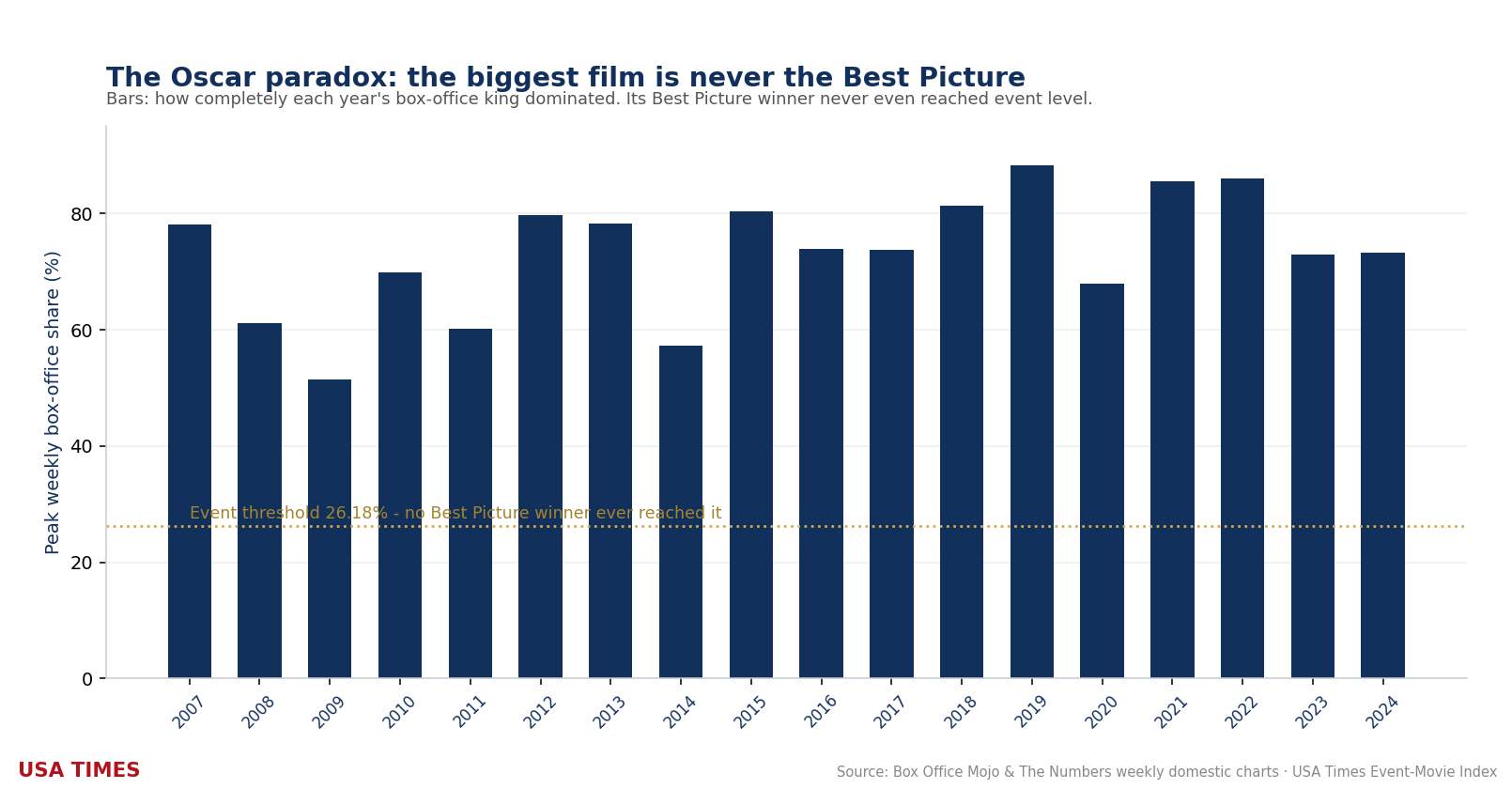
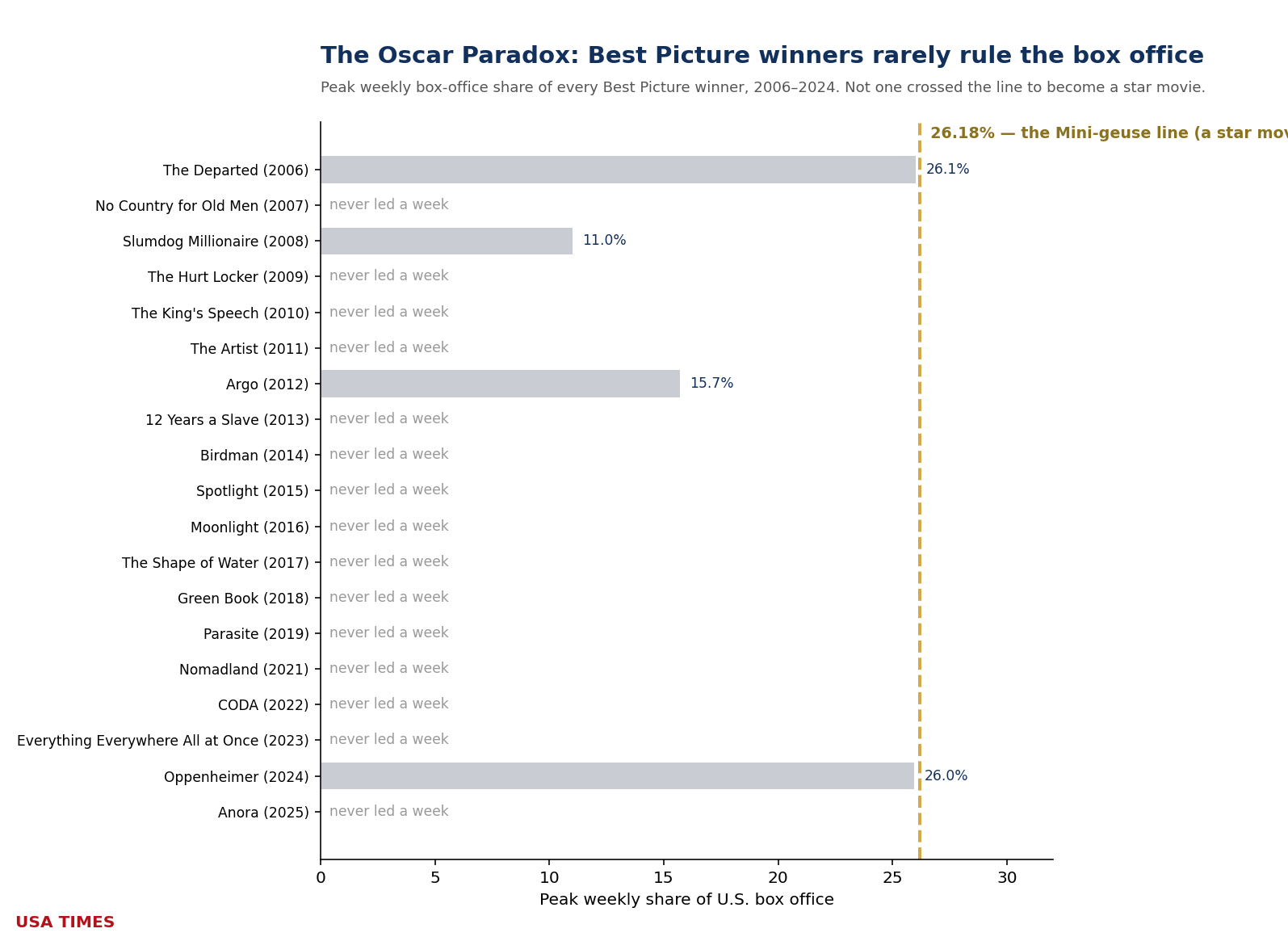
Here is a fact that sounds impossible until you check it. Over the last eighteen years, not one film that won the Academy Award for Best Picture ever dominated a single week at the American box office — not one reached even the lowest rung of the USA Times index, the 26.18% Mini-geuse threshold. The most celebrated film of each year, by Hollywood’s own reckoning, is essentially never the film that owned the year’s box office. The two crowns almost never touch.
Two different definitions of “best”
The chart tells the story at a glance. Each bar is how completely that year’s true box-office king dominated its biggest week — often soaring past 60%. The Best Picture winner, in every single one of those years, sits below the golden Mini-geuse line, invisible on this scale. Everything Everywhere All at Once, Nomadland, CODA, Moonlight, Parasite — brilliant, beloved films, and box-office featherweights next to the tentpoles that actually ruled their calendars.
| Year | Best Picture winner | The film that actually owned the box office |
|---|---|---|
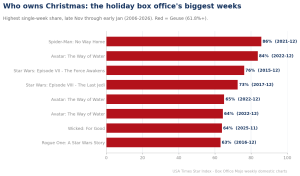
| 2024 | Anora | Inside Out 2 (73%) |
| 2023 | Oppenheimer | Guardians of the Galaxy Vol. 3 (73%) |
| 2022 | Everything Everywhere All at Once | Black Panther: Wakanda Forever (86%) |
| 2021 | CODA | Spider-Man: No Way Home (86%) |
| 2020 | Nomadland | The Croods: A New Age (68%) |
| 2019 | Parasite | Avengers: Endgame (88%) |
| 2018 | Green Book | Avengers: Infinity War (81%) |
| 2017 | The Shape of Water | Guardians of the Galaxy Vol. 2 (74%) |
| 2016 | Moonlight | Captain America: Civil War (74%) |
| 2015 | Spotlight | Avengers: Age of Ultron (80%) |
| 2014 | Birdman | The Amazing Spider-Man 2 (57%) |
| 2013 | 12 Years a Slave | Iron Man 3 (78%) |
The closest the two ever came
The nearest miss is instructive. In 2023, Oppenheimer won Best Picture and was a genuine cultural juggernaut — yet even it never took an event-level share of a single week, because it opened alongside Barbie, which swallowed the market while Oppenheimer played the loyal runner-up. A three-hour talky biopic about theoretical physics came closer to uniting the two crowns than any film in years, and still fell short of the box-office throne. That is how wide the gap has become.
Batmandir · The Circle Full access to theatres, museums & exhibitions. S2 · ongoing membership, without a Founder’s seat. Explore membership →Why the crowns drifted apart
It was not always this way. In earlier eras, epics like Titanic, The Lord of the Rings: The Return of the King, or Ben-Hur won Best Picture and owned the box office. The split is a symptom of the same concentration story this index keeps telling. As the market consolidated around franchise spectacle, the films that dominate weeks became almost exclusively sequels and superhero entries — the very genres the Academy has spent two decades declining to crown. Meanwhile prestige dramas migrated to specialty releases and, increasingly, to streaming, where they win awards without ever needing to conquer a box-office weekend.
None of this means either metric is fake. They measure different things. Our index measures domination — how completely a film commanded the market in a moment. The Oscar measures something closer to craft, ambition, and the taste of several thousand industry voters. That the two now point at entirely different movies is not a scandal; it is a portrait of a bifurcated business, where the films that make the money and the films that win the awards have quietly become two separate cinemas. The golden ratio can tell you which film owned the year. It has nothing to say about which one deserved to.