If you have ever watched a Christopher Nolan film at home and noticed the image suddenly grow taller — the black bars shrinking, the picture swelling to fill your whole television — you have seen the ghost of IMAX. Those expanding scenes are the sequences the director shot with giant-format IMAX cameras, and a handful of 4K Blu-rays and streaming releases preserve them. But there is a catch that trips up even devoted fans: what you are seeing at home is never the true 1.43:1 IMAX frame. Here is exactly what you get, and why.
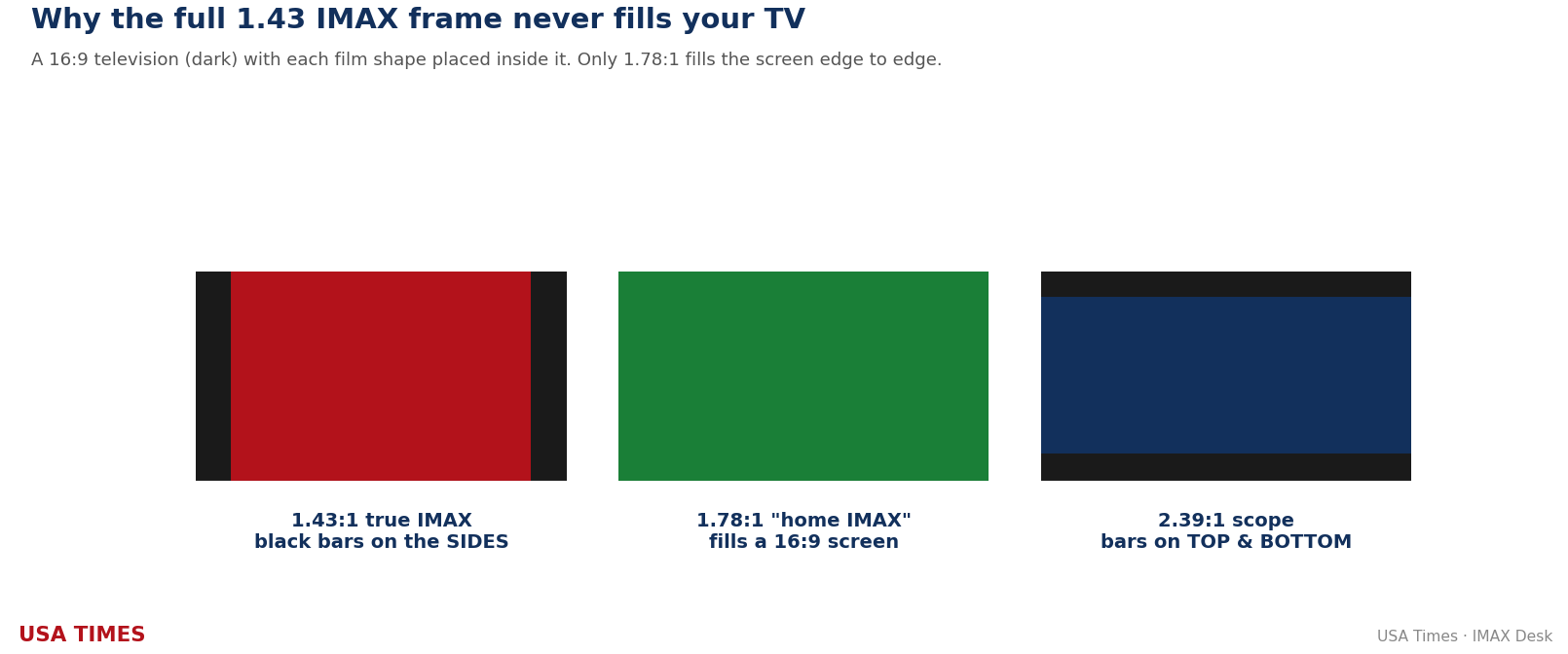
The 1.43 problem, in one diagram
The full theatrical IMAX frame is 1.43:1 — nearly square, taller than it is wide by cinema standards. Your television is 1.78:1 (16:9), a wider rectangle. Put the true IMAX shape on your TV and it would have to be pillarboxed, with black bars down the left and right, because it is taller than the screen allows. No studio wants to ship a blockbuster that looks letterboxed on the sides, so home releases quietly crop the 1.43:1 frame down to about 1.78:1 — sacrificing a sliver of the top and bottom so the image fills your screen edge to edge. You gain a full-screen picture; you lose the last inch of the sky.
This is why the term “IMAX at home” is always a little bit of a fib. The content of the expanded scenes is there — the extra vertical information Nolan and others captured — but the shape is compromised. The only place the genuine 1.43:1 frame exists is on a handful of enormous theatrical screens, which is precisely what makes the format worth chasing in a cinema.
Batmandir · The Circle Full access to theatres, museums & exhibitions. S2 · ongoing membership, without a Founder’s seat. Explore membership →The films that expand at home
Not every IMAX-shot film preserves its expanded scenes on home video — some are locked to a single wide ratio for consistency. These are the notable releases that do open up, and what you actually see when they do.
| Film | Where | What you get at home |
|---|---|---|
| Interstellar (2014) | 4K Blu-ray | Expanded IMAX scenes open up to ~1.78:1 and fill the screen |
| Dunkirk (2017) | 4K Blu-ray | Shifts between ~1.78:1 (IMAX) and 2.39:1 throughout |
| Oppenheimer (2023) | 4K Blu-ray | IMAX-shot sequences preserved, expanding to fill 16:9 |
| Tenet (2020) | 4K Blu-ray | Variable ratio; IMAX scenes widen to ~1.78:1 |
| Avengers: Infinity War (2018) | Disney+ / disc | Expanded IMAX version fills the whole screen on Disney+ |
| Avengers: Endgame (2019) | Disney+ / disc | Full-frame IMAX presentation streams in 1.78:1 |
| Mission: Impossible – Fallout (2018) | 4K Blu-ray | IMAX-photographed shots expand from 2.39:1 |
| Zack Snyder’s Justice League (2021) | Max / disc | Presented entirely in the boxy 1.33:1 — the closest to true IMAX shape |
| Star Trek Into Darkness (2013) | 4K Blu-ray | Early IMAX sequences open up to the taller frame |
| Transformers: Age of Extinction (2014) | 4K Blu-ray | Variable IMAX ratio on select scenes |
The closest you can get: 1.33 and the Snyder exception
The single most faithful home presentation of the IMAX shape is a surprise: Zack Snyder’s Justice League, released in a boxy 1.33:1 across its entire runtime. That squarish frame is even taller than 1.43:1, so it too pillarboxes on a 16:9 TV — but it gives home viewers the rare experience of a whole film in the tall, immersive proportions IMAX fans love, black side-bars and all. It divided audiences precisely because it refused the usual compromise. Love it or hate it, it is the closest your living room gets to the real thing.
A few practical notes for collectors. Physical 4K Blu-ray almost always preserves the expanded scenes more faithfully than streaming, where platforms sometimes flatten everything to a single ratio to avoid confusing viewers. Disney+ is the notable exception, offering genuine expanded-frame “IMAX Enhanced” versions of several Marvel titles. And if a disc lists a “variable” or “expanded” aspect ratio on the back, that is your signal: the picture will breathe.
The honest bottom line, for anyone building an IMAX shelf: home media can give you the scenes Nolan and his peers shot in giant format, and on a big 4K television they look spectacular. What it cannot give you is the true 1.43:1 frame — the tall, enveloping square that only exists on a handful of screens the size of a house. That gap between the living room and the giant screen is not a flaw in your setup. It is the entire reason the format still matters, and the reason a movie like The Odyssey can sell out theaters a year in advance while streaming to nobody at all.
Why studios crop the frame at all
The decision to shrink the true 1.43:1 IMAX frame down to a wider ratio for home release is a commercial one, not an artistic one, and it reveals how much the living room still shapes how films are delivered. A studio could, in principle, ship the full tall frame on a disc; it chooses not to, because the pillarboxed image — with thick black bars down both sides of a widescreen television — reads to most viewers as a mistake or a defect rather than a faithful presentation. Rather than field complaints about “bars on the sides,” studios crop the image to fill the 16:9 screen, trading fidelity for the appearance of a full picture. It is a rational choice about consumer expectations, and it is why the genuine IMAX shape remains a theatrical exclusive.
The result is a quiet irony at the heart of “IMAX at home” marketing: the very feature being sold — the expanded, immersive frame — is the one that cannot survive the trip to a television. What the home viewer receives is the expanded content, the extra picture information the filmmaker captured, reshaped into a compromise ratio. On a large, high-quality display it still looks spectacular, and for the vast majority of viewers it is more than enough. But the gap between that compromise and the true theatrical frame is real, and it is precisely the gap that keeps the giant screen worth seeking out.
For collectors building a home library, the practical takeaway is to read the fine print: physical 4K discs generally preserve the expanded sequences more faithfully than streaming, which sometimes flattens everything to a single ratio, and a disc that advertises a “variable” or “expanded” aspect ratio is signaling that the picture will breathe. Knowing what to look for is the difference between owning the fullest home version of a film and owning a needlessly cropped one.
Related from the USA Times Data Desk
- IMAX Aspect Ratios, Explained: 1.43:1 vs 1.90:1 — and How to Tell What You’re Really Getting
- The IMAX Passport: 55 of the Last 58 Box-Office Geuses Opened on the Giant Screen (2006–2026)
- IMAX Just Had Its Best Q2 Installation Quarter in a Decade. Its Backlog Grew Anyway.
- Every Screen on Earth That Can Show The Odyssey in True IMAX 70mm — All 41 of Them
- Box-office coverage index · the Star Index methodology
Sources
- Box Office Mojo — Weekend Domestic Box Office
- Box Office Mojo — Yearly Domestic Box Office
- IMAX — format & venue background (Wikipedia)
- USA Times — Star Index methodology & data sources