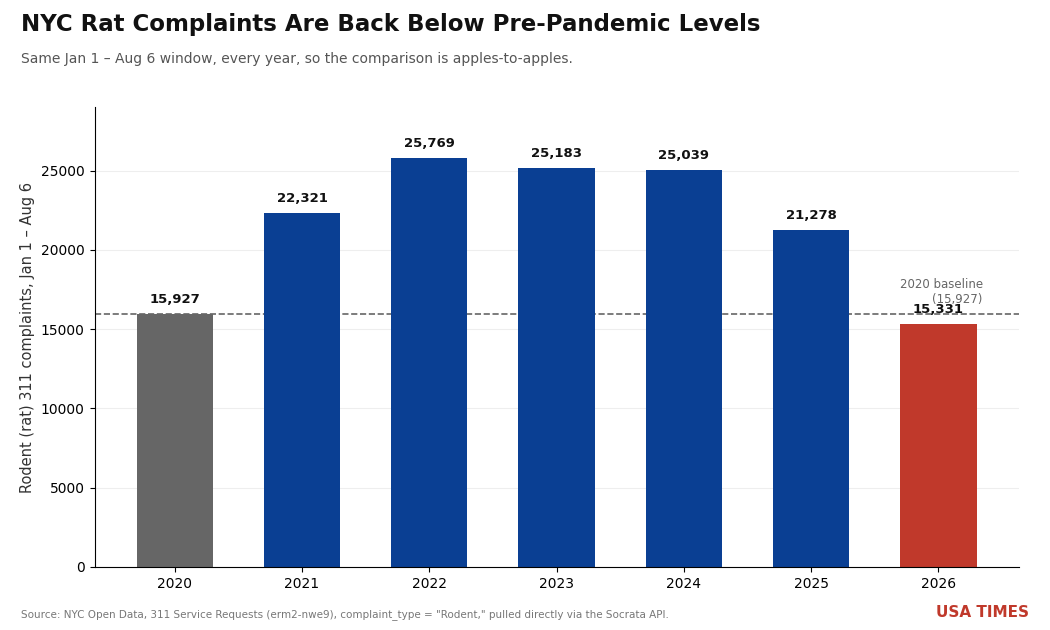
New York’s rat problem became a national punchline in 2021, when 311 rodent complaints jumped 40% in a single year. Five years later, the city’s own open-data portal shows something that hasn’t been true since before that surge: rat complaints filed so far this year are now lower than they were over the same stretch of 2020 — the last full year before the pandemic-era spike began.
We pulled the raw numbers directly from NYC’s 311 Service Requests dataset, filtering for complaint type “Rodent” and comparing the same January 1 to August 6 window in every year from 2020 through 2026, so the comparison isn’t distorted by which months happen to be included in a partial year.
NYC Rat (Rodent) 311 Complaints, Jan 1 – Aug 6, by Year
Batmandir · Guest Passes Step inside for a day. Guest passes from $161/day — brought in by a member. See guest passes →Same date window every year, pulled directly from NYC Open Data. Hover a bar for the exact count and year-over-year change.
The numbers, year by year
Rat complaints for the Jan 1–Aug 6 window: 15,927 in 2020, jumping to 22,321 in 2021 and climbing further to a peak of 25,769 in 2022. They stayed roughly flat through 2023 (25,183) and 2024 (25,039) — two years in a row essentially pinned near the post-pandemic high. Then the trend reversed hard: 21,278 for the same window in 2025, a 15% drop from 2024, and 15,331 so far in 2026 — a further 28% drop from 2025, and now slightly below where the city stood in 2020, before any of this started.
What changed between the peak and now
Two policy moves sit inside that window. In April 2023, Mayor Eric Adams named Kathleen Corradi as the city’s first-ever citywide director of rodent mitigation — widely covered as the “rat czar” — tasked with coordinating rat-reduction work across sanitation, health, parks, and community programs, including new rat mitigation zones in neighborhoods like Harlem.
The bigger structural change came later: starting November 12, 2024, the Department of Sanitation required all low-density residential buildings (one to nine units) to set out trash in secured bins rather than loose bags on the curb, covering roughly 70% of the city’s total trash volume. Warnings ran through the end of 2024; fines for noncompliance began January 2, 2025 — right at the start of the window where the complaint numbers start dropping in our data.
DSNY’s own reporting credits the containerization rule directly: the department has said rat sightings reported to 311 declined for 12 consecutive months on a year-over-year basis, for a cumulative decline of more than 20%. That’s a different comparison window than ours — DSNY is measuring rolling month-over-month year-over-year changes, we’re measuring a fixed Jan–Aug span — but the two independent counts point in the same direction and land in a similar range, which is a reasonable cross-check that neither number is an artifact of how the window was chosen.
The decline isn’t even across the city
We broke the same Jan 1–Aug 6 comparison down by borough, using 2024 (the peak year) against 2026 (the current year), to see whether the citywide drop is uniform or concentrated somewhere specific. It’s not uniform. Manhattan fell the most in percentage terms, down 43.1% (from 6,299 complaints to 3,582). Brooklyn — which files more rat complaints than any other borough in absolute numbers — fell almost as much, down 42.6% (9,790 to 5,615). The Bronx dropped 36.5% and Queens 31.4%. Staten Island, which has by far the fewest complaints of any borough to begin with, improved the least in percentage terms, down 20.9% (807 to 638).
The pattern roughly tracks building density and how much of each borough’s housing stock is covered by the low-density containerization rule that took effect in November 2024. Manhattan and Brooklyn, with more of the city’s highest-density blocks and — per DSNY’s rollout — some of the most closely monitored enforcement zones, show the sharpest declines. Staten Island, the most suburban and lowest-density borough, was always going to see a smaller mechanical effect from a rule aimed primarily at how densely packed buildings set out trash.
The rat czar left anyway
Corradi stepped down from the role in October 2025, after roughly two and a half years — while the complaint numbers were already trending down. Coverage of her exit split along predictable lines: some outlets framed it as a quiet acknowledgment that the position had done its job and could be absorbed back into existing agency structures; at least one ran a more skeptical “did the war on rats fail” framing, noting that a declining-complaints trend doesn’t necessarily mean a declining rat population, and that the city hasn’t published an independent rat-population estimate to compare against the complaint data.
That skepticism points at a real limitation of this entire dataset, on both sides of the debate: 311 complaint counts measure how often New Yorkers report seeing a rat, not how many rats exist. A drop in complaints is consistent with fewer rats, but it’s also consistent with rats moving to areas people don’t report from as often, residents growing fatigued with filing complaints that don’t change anything, or awareness campaigns changing what people bother to report. The city’s containerization rule has a plausible, mechanical reason to reduce sightings regardless of the underlying rat population — sealed bins mean less food waste sitting exposed on sidewalks — which is a stronger causal story than most 311-trend narratives get to claim, but it’s still not a rat census.
What we did
We queried NYC Open Data’s 311 Service Requests dataset (erm2-nwe9) directly through its public API, filtering for complaint_type = "Rodent" and counting records within the same January 1–August 6 date range for each year from 2020 through 2026, to keep the comparison free of seasonal distortion from partial-year data. We then cross-checked the resulting trend against the Department of Sanitation’s own published rolling year-over-year decline figures and against news coverage of the November 2024 containerization rule and Kathleen Corradi’s April 2023 appointment and October 2025 departure, to confirm the timeline of policy changes lines up with where the data actually shifts. The borough breakdown was pulled the same way, filtered to the peak year (2024) and the current year (2026) over the identical Jan 1–Aug 6 window, grouped by the dataset’s own borough field.
Related from the USA Times Data Desk
- One-Week Wonders: The Box Office’s Shooting Stars
- The Secret in Our Stars: The Golden-Ratio Math Hidden in the USA Times Logo
- The Efficiency Champions: How Cheap Horror Owns the Box Office
- Box Office Tracker: "Minions & Monsters" mantém o 1º lugar e "Michael" ultrapassa US$ 371 mi sem alarde
- Box-office coverage index · the Star Index methodology