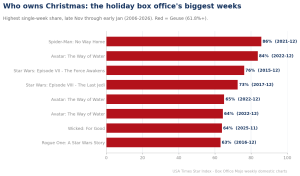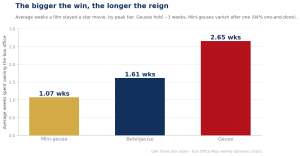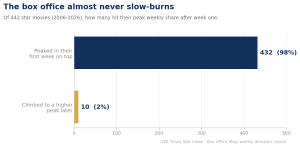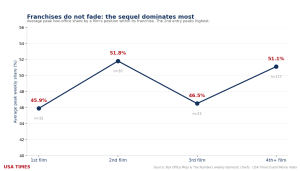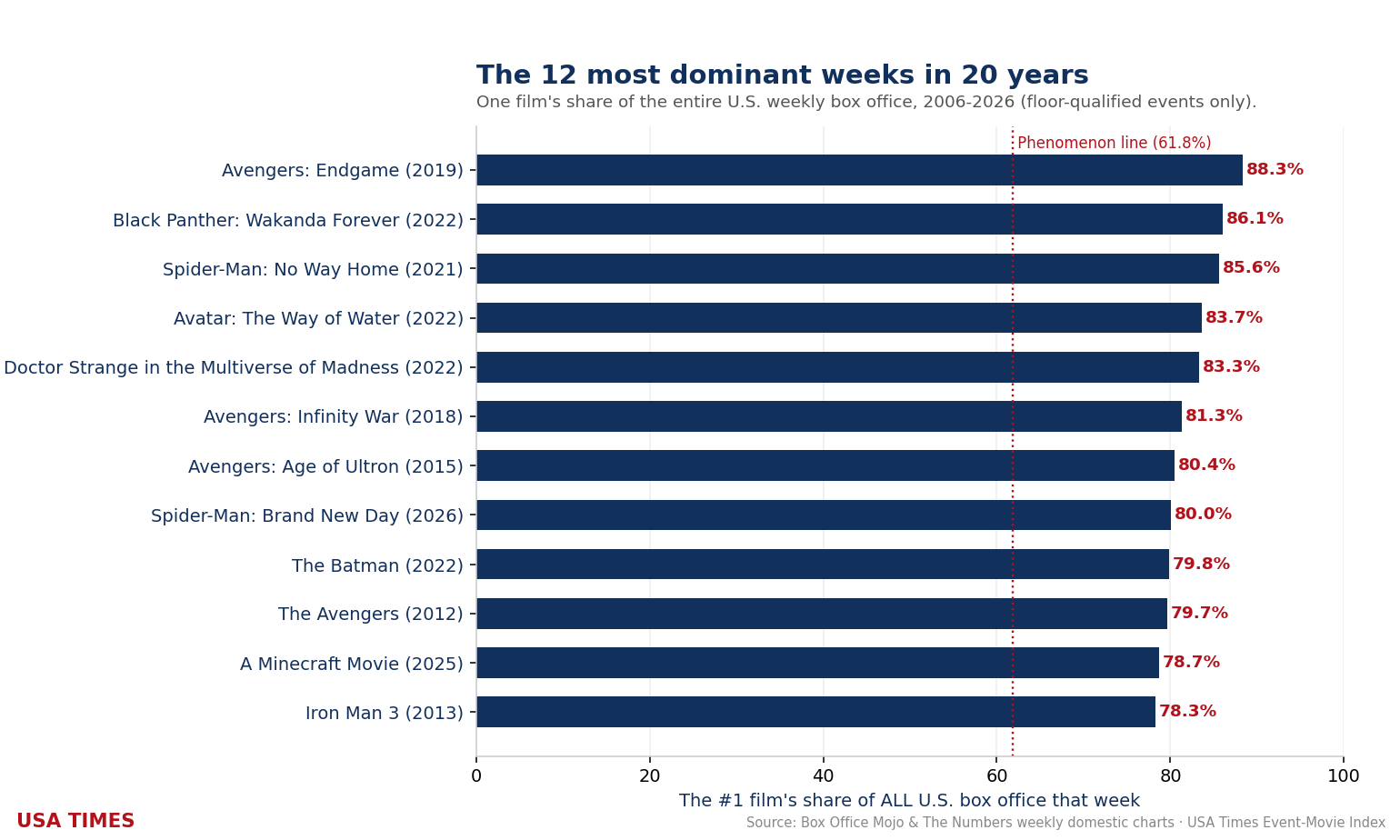
Most weekend box-office stories are about dollars. This one is about share — what fraction of every ticket sold in America in a given week went to a single film. By the USA Times Star Index, a film that takes 61.8% of the entire week is a “Geuse.” These twelve weeks blew past that line and kept climbing. They are the most total a single movie has ever owned the American box office.
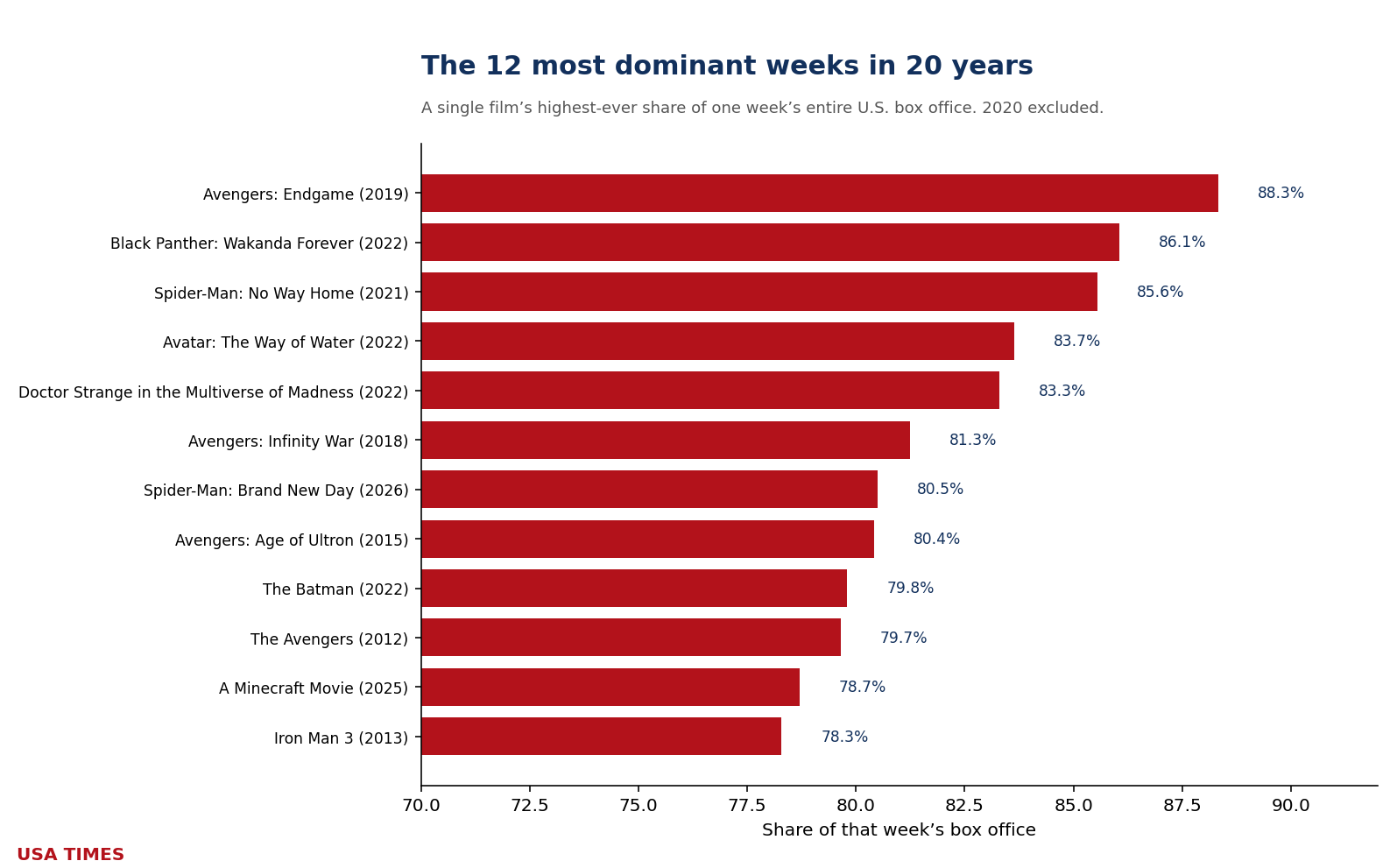
The record book
At the very top sits Avengers: Endgame , which in its opening week of 2019 took a barely-believable 88.4% of all money spent at U.S. theaters — nearly nine of every ten dollars. For one week, the rest of the movie business was a rounding error.
| # | Film | Year | Peak week share |
|---|---|---|---|
| 1 | Avengers: Endgame | 2019 | 88.3% |
| 2 | Black Panther: Wakanda Forever | 2022 | 86.1% |
| 3 | Spider-Man: No Way Home | 2021 | 85.6% |
| 4 | Avatar: The Way of Water | 2022 | 83.7% |
| 5 | Doctor Strange in the Multiverse of Madness | 2022 | 83.3% |
| 6 | Avengers: Infinity War | 2018 | 81.3% |
| 7 | Avengers: Age of Ultron | 2015 | 80.4% |
| 8 | Spider-Man: Brand New Day | 2026 | 80.0% |
| 9 | The Batman | 2022 | 79.8% |
| 10 | The Avengers | 2012 | 79.7% |
It’s almost all Marvel
Look at the names. Ten of the twelve are comic-book films, and eight of those are Marvel: three Avengers pictures, two Spider-Mans, Doctor Strange, Iron Man 3, and 2022’s Black Panther: Wakanda Forever. The only non-superhero entries are Avatar: The Way of Water and, this year, A Minecraft Movie — and both are event machines in their own right. The green stars mark the Billion-Dollar Club: one star for every $1 billion a film earned worldwide.
What the leaderboard really measures is not popularity but timing — a film big enough to open on a weekend so empty of competition that it swallows the whole market. That is a strategy as much as a geuse: the biggest releases now clear their runways, opening when nothing else dares, and the result is a handful of weeks each decade where American moviegoing is, functionally, one film.
The anatomy of a dominant week
What actually produces a week this lopsided? Not simply a big film — the box office is full of big films that never take 80% of a week — but a big film opening into a deliberately cleared field. The weeks at the top of this leaderboard share a common backstage story: a studio identified a release date months or years in advance, and rivals, recognizing the coming juggernaut, fled to other weekends rather than be crushed. The result is a self-reinforcing vacuum. The giant opens against almost nothing, sweeps up a colossal share, and the very absence of competition that its reputation created becomes the mechanism of its domination. These weeks are as much a triumph of scheduling nerve as of the films themselves.
This is why the leaderboard rewards a particular species of film: the pre-sold, four-quadrant event with a fanbase large enough to guarantee a massive opening and a brand powerful enough to scare off competition. A brilliant film with a modest marketing footprint can never appear here, no matter how beloved, because it will always open alongside other films drawing their own crowds. Domination on this scale is not a measure of quality; it is a measure of a film’s ability to empty the calendar around itself.
Why it is almost all superheroes
The heavy concentration of comic-book films near the top of the list is not a coincidence but a structural fact about the modern box office. Superhero franchises are the only reliable machines for manufacturing the two conditions a dominant week requires simultaneously: an enormous, committed opening-weekend audience, and a brand so intimidating that competitors clear the runway. A new Avengers or Spider-Man installment arrives with both built in. Very few other films — a new Avatar, a rare cultural geuse like a Barbie — can summon the same combination, which is why the non-superhero entries on the list are so few and so memorable. The record book of domination is, in large part, a record of the two decades in which the superhero film became the organizing principle of American moviegoing.
Domination is a moment, not a lifetime
A crucial caveat keeps the leaderboard honest: it ranks the single most dominant week each film ever posted, not its total gross, its profitability, or its quality. A film can take 80% of one week and still earn less over its full run than a film that never cracked 50% of any week but held the top for months. The most dominant weeks are snapshots of maximum force — the instant a film came closest to being the only movie in America — and that instant is a genuine and fascinating thing to measure. But it is not the same as being the biggest film of the year, and the two lists, while they overlap, are not identical. What this leaderboard captures is the peak of the wave, not the volume of the ocean.
The paradox of the empty theater next door
There is a paradox worth sitting with in these numbers. The most dominant weeks in American history are also, in a sense, the loneliest — weeks in which one film’s triumph came at the cost of nearly everything else playing. When a single title takes 85% of a week, the other screens in the multiplex are running to sparse crowds, and the diversity of choice that a healthy box office offers has collapsed to a single overwhelming option. From the studio’s perspective these are the greatest weeks imaginable; from the perspective of a varied moviegoing culture they are something more ambiguous. The record book of domination is, read another way, a record of the moments American moviegoing came closest to being a monoculture — everyone in the same theater, watching the same film, because there was effectively nothing else to see.
That ambiguity is the throughline of the entire USA Times Star Index. Domination is genuinely impressive and genuinely worth measuring, but it is not an unalloyed good. The weeks on this leaderboard represent both the peak of what a blockbuster can achieve and the point at which the market is least plural. Holding both ideas at once — awe at the scale, unease at the concentration — is the honest way to read a list like this, and it is the posture the index tries to model throughout its coverage.
Related from the USA Times Data Desk
- The Betelgeuse-Betelgeuse Week Has Happened Once in Twenty Years. Our Editor-in-Chief Bets December 18 Won't Be the Second.
- Holding the Throne: The Films That Stayed a Box-Office Geuse Two Weeks Running (2006–2026)
- One-Week Wonders: The Box Office’s Shooting Stars
- You Can Never Have Four: The Hidden Math That Governs the Box Office
- Box-office coverage index · the Star Index methodology
Sources
- Box Office Mojo — Weekend Domestic Box Office
- Box Office Mojo — Yearly Domestic Box Office
- The Numbers — Weekly Box Office Chart
- USA Times — Star Index methodology & data sources