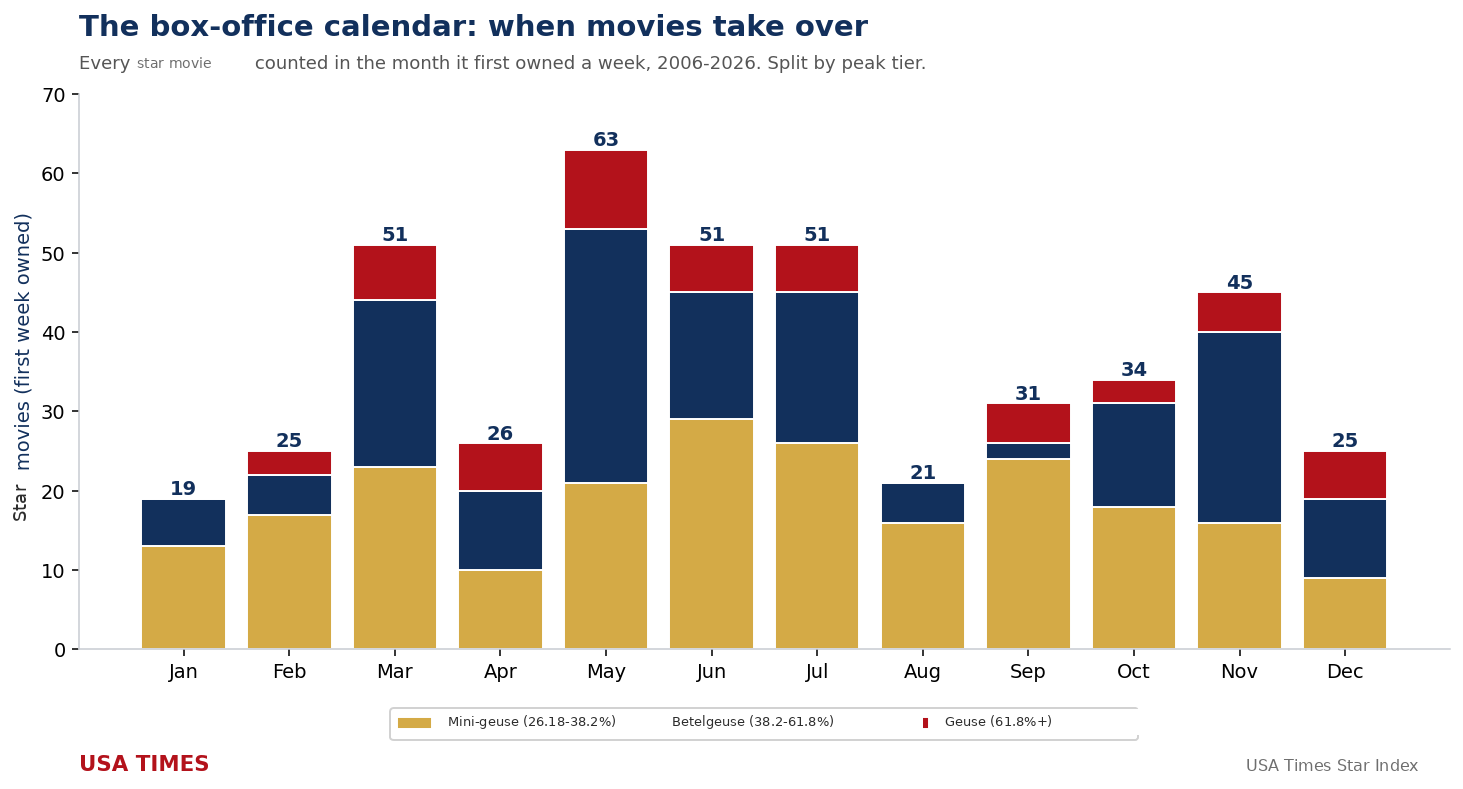
Blockbusters do not arrive at random. They cluster around a handful of launch windows the industry has spent decades optimizing — and they leave long stretches of the calendar almost empty. Map every star movie of the last twenty years to the month it first owned a week, and the year splits cleanly into gold rushes and ghost towns.
The gold-rush months
May is the undisputed king, with 63 star movies over twenty years and ten outright Geuses — the traditional start of the summer season, when studios fire their biggest guns. Close behind come March, June and July, each crowning about fifty star movies. Spring and summer together are where domination is manufactured.
The two dead zones
Here is the finding that surprised us most. In twenty years, not one film released in January or August has ever become a Geuse — not a single movie opening in those months has taken 62% or more of the entire U.S. box office. January is the post-holiday hangover; August is the late-summer lull. Films still own weeks in these months, but only by default, against weak competition. The ceiling is real: some windows simply do not produce total domination.
Batmandir · The Circle Full access to theatres, museums & exhibitions. S2 · ongoing membership, without a Founder’s seat. Explore membership →December: few films, but the most lethal
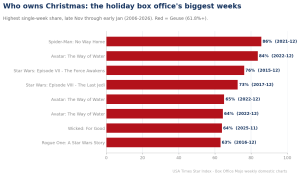
December looks quiet by volume — just 25 star movies, fewer than sleepy October. But look closer and it is the most potent month on the calendar: of those 25 films, six became Geuses and ten more were Betelgeuses. Studios release very little in late December, but what they do release — the Avatars, the Star Wars chapters, the year-end Spider-Man — tends to flatten everything around it. Quality of domination, not quantity.
The calendar, in other words, is not neutral. A movie’s odds of becoming an event — and how completely it can dominate — are set in part before a single ticket is sold, by the month a studio chooses to release it.
Why the calendar is not neutral
The most important thing the box-office calendar reveals is that a film’s fate is partly written before a single ticket is sold, in the choice of when to release it. The same movie that opens into the cleared runway of early May, with rivals fleeing the date, will post a very different share than it would opening into the crowded scrum of a competitive fall weekend. Timing is not a footnote to a film’s performance; it is one of its largest determinants. Studios understand this intimately, which is why the biggest tentpole dates are claimed years in advance and defended like territory, and why a mid-budget film can be quietly killed simply by being slotted into a graveyard weekend where it will be smothered.
This is why the concentration of star movies into a handful of months is self-reinforcing rather than accidental. Studios release their giants when audiences are most available — summer break, the winter holidays — and audiences, in turn, come to expect the giants then, which deepens the clustering further. The dead zones are dead not because no one goes to the movies in late January or early September, but because studios have collectively decided not to send their best films there, and the audience has learned there is little worth showing up for. The calendar is a coordination equilibrium, and once established, it is remarkably stable.
The two engines: summer and the holidays
The two great tentpole corridors run on slightly different logic. The summer season, which now effectively begins in late April or early May, is built on the long school break and the appetite for spectacle — it is the home of the superhero film, the action sequel, the four-quadrant blockbuster designed to be seen big and loud. The winter holiday corridor, running from Thanksgiving through the first days of January, runs on a different fuel: the enormous pool of free time and family togetherness that the holidays create, which rewards animation, prestige awards contenders, and the kind of broad crowd-pleaser that three generations can attend together. Between them, these two windows account for the overwhelming majority of the year’s Geuses, and the films that own them tend to become the year’s biggest earners.
The strategic value of a dead zone
It would be a mistake to think the dead zones are worthless, however. For the right film, a quiet month is not a graveyard but an opportunity — a chance to own a weekend cheaply, against weak competition, that a stronger date would never allow. Counter-programmers and genre films, particularly horror, have learned to exploit the dead zones deliberately, opening into January or late summer precisely because the field is empty. A modest film that would vanish in the summer crush can lead the entire box office in February simply because nothing else is trying. The dead zones, in other words, are dead only for the giants; for a nimble, well-targeted release, they can be the easiest weeks of the year to win.
A caveat on method: this analysis counts each star movie in the month it first reached event level, which is generally its opening. Films that open at the end of one month and dominate into the next are credited to the earlier month, and the boundaries between adjacent months are necessarily a little fuzzy. But the broad seasonal shape — two great tentpole engines, two dead zones, and a competitive middle — is robust to any reasonable way of drawing the lines, and it matches what anyone who follows the release calendar already feels in their bones.
The calendar is also slowly changing shape. As studios have grown more aggressive about claiming prime real estate, the tentpole windows have crept outward — “summer” now starts in April, and the holiday push begins before Thanksgiving — steadily eating into the shoulder months that once belonged to smaller films. The dead zones are not disappearing, but they are shifting, and the competitive middle of the calendar is being squeezed from both ends. Watching where the star movies cluster, year over year, is therefore a way of watching the tentpole era expand its footprint across the twelve months, one formerly quiet weekend at a time.
Related from the USA Times Data Desk
- Box Office Tracker: "Minions & Monsters" Holds No. 1, "Michael" Quietly Crosses $371M
- The 38.2% Club: The ‘Betelgeuses’ That Run the Box Office
- Box Office Tracker: "Minions & Monsters" mantém o 1º lugar e "Michael" ultrapassa US$ 371 mi sem alarde
- One-Week Wonders: The Box Office’s Shooting Stars
- Box-office coverage index · the Star Index methodology
Sources
- Box Office Mojo — Weekend Domestic Box Office
- Box Office Mojo — Yearly Domestic Box Office
- The Numbers — Weekly Box Office Chart
- USA Times — Star Index methodology & data sources