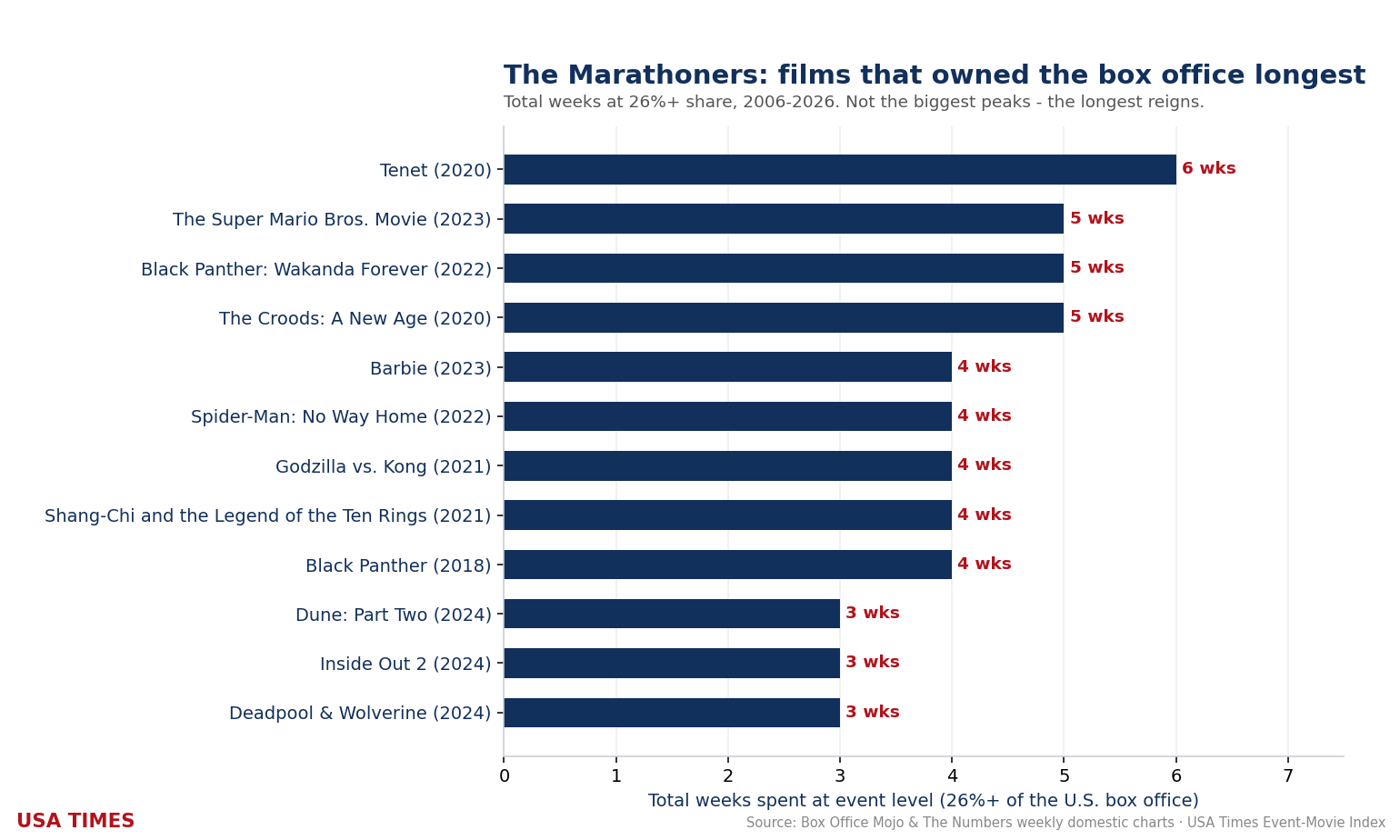
Yesterday’s heroes fade fast at the box office — two out of three star movies own the market for a single week and then vanish. But a rare few refuse to leave. These are the marathoners: not the films with the highest single-week peak, but the ones that stayed at event level — 26% or more of the entire U.S. box office — week after week after week.
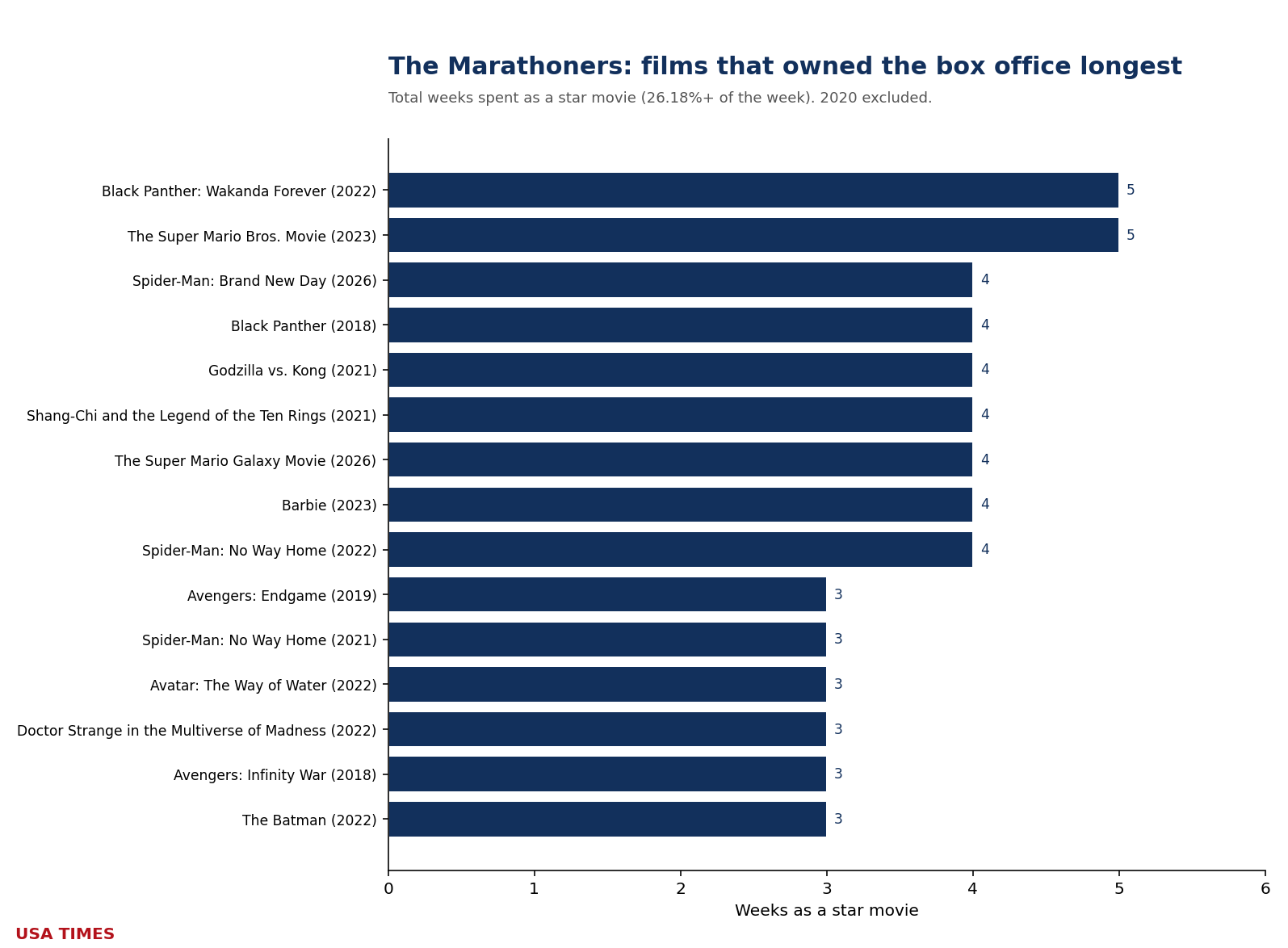
Endurance, not explosion
The longest reign belongs to Tenet (2020), which held event-level share for 6 straight weeks. It is a revealing list, because these are not always the flashiest openers. A marathoner wins by legs — strong word of mouth, repeat viewings, and a release calendar that happened not to throw a bigger giant at it too soon.
| # | Film | Year | Weeks at event level | Peak share |
|---|---|---|---|---|
| 1 | Tenet | 2020 | 6 | 58.6% |
| 2 | The Super Mario Bros. Movie | 2023 | 5 | 71.1% |
| 3 | Black Panther: Wakanda Forever | 2022 | 5 | 86.1% |
| 4 | The Croods: A New Age | 2020 | 5 | 67.9% |
| 5 | Barbie | 2023 | 4 | 52.5% |
| 6 | Spider-Man: No Way Home | 2022 | 4 | 51.0% |
| 7 | Godzilla vs. Kong | 2021 | 4 | 69.4% |
| 8 | Shang-Chi and the Legend of the Ten Rings | 2021 | 4 | 68.1% |
| 9 | Black Panther | 2018 | 4 | 69.6% |
| 10 | Dune: Part Two | 2024 | 3 | 71.2% |
A caveat worth naming: a few of these long runs, Tenet chief among them, were extended by the pandemic, when a thin release slate left the same film on top for weeks simply because nothing new arrived to challenge it. But most of the marathoners earned their endurance the old-fashioned way — by being the movie audiences kept coming back to. In an era engineered for disposable domination, staying power is the rarest achievement of all.
Batmandir · Guest Passes Step inside for a day. Guest passes from $161/day — brought in by a member. See guest passes →Why endurance is harder than it looks
Staying at event level for week after week is a fundamentally different achievement than opening huge, and a far rarer one in the modern era. An enormous opening is a function of anticipation, marketing spend, and a cleared release date — things a studio can largely engineer in advance. Endurance cannot be bought. It requires the one thing no marketing budget can manufacture: genuine word of mouth, the audience telling other audiences that a film is worth the trip, week after week, faster than the novelty fades. The marathoners on this list are, almost by definition, the films people actually loved rather than merely showed up for on opening weekend.
That is why the list skews toward a particular kind of film — the crowd-pleaser with legs, the four-quadrant hit that families and casual moviegoers return to over a long holiday window, the sleeper that builds rather than front-loads. It is also why the modern release calendar makes endurance so much harder than it once was. A film can have tremendous legs and still be shoved off the top of the chart by next week’s giant, no matter how strong its word of mouth. In an era engineered for weekly turnover, simply refusing to leave the throne is a genuine act of resistance.
Peak versus endurance: two different crowns
It is worth separating the two things this index measures, because the marathoners expose the difference vividly. A film’s peak share captures how completely it dominated its single biggest week — a snapshot of maximum force. Its endurance captures how long it stayed relevant — a measure of stamina. These are not the same, and the films that excel at one often do not excel at the other. A superhero tentpole might post a towering peak share on opening weekend and then collapse; a beloved animated film might never quite reach that peak but hold event-level share for a month. The marathoners are the stamina champions, and their names are frequently different from the peak champions precisely because the two virtues rarely coincide in the same film.
The pandemic asterisk, in full
A handful of the longest runs in the data carry an unavoidable caveat: they were extended by the pandemic, when a threadbare release slate left the same film on top for weeks simply because nothing new arrived to challenge it. A long reign against no competition is not the same feat as a long reign against a full calendar, and the honest reader should discount those pandemic-era runs accordingly. But most of the marathoners earned their endurance the old-fashioned way, holding audiences against real competition through the sheer fact of being the film people wanted to see. Those are the runs worth celebrating — the ones that prove staying power is still possible, even in a market built to forget last week’s hit by Friday.
As with every ranking in the index, one limit applies: this measures weeks spent at event level, not total dollars earned or quality delivered. A film can rack up an enormous gross without a long event-level run, and vice versa. What the marathoners capture is something more specific and, in its way, more human than money — the rare films audiences refused to let go of.
What endurance says about a film
There is a reason the marathoners tend to be remembered fondly years later while many bigger openers are forgotten. A long run at the top is, in effect, a continuously renewed verdict from the audience: every week a film holds its ground, the public is voting again in its favor, choosing it over whatever new options arrived. That repeated endorsement is a far better signal of a film’s genuine connection with viewers than a single explosive opening, which measures anticipation more than satisfaction. The marathoners are the films that turned curiosity into affection, and affection into the kind of repeat and word-of-mouth business that keeps a title on top when the marketing spend has long since stopped. In an industry that increasingly optimizes for the opening-weekend spike, endurance remains the truest measure of whether a film actually delivered — and the shortening of these runs over time is one more quiet cost of a box office engineered for the sprint rather than the marathon.
Related from the USA Times Data Desk
- Wikipedia le atribuye a una película de Bollywood de 1982 casi el doble de la recaudación de Sholay. Sus citas son sobre películas completamente distintas.
- One-Week Wonders: The Box Office’s Shooting Stars
- The Betelgeuse-Betelgeuse Week Has Happened Once in Twenty Years. Our Editor-in-Chief Bets December 18 Won't Be the Second.
- The Secret in Our Stars: The Golden-Ratio Math Hidden in the USA Times Logo
- Box-office coverage index · the Star Index methodology