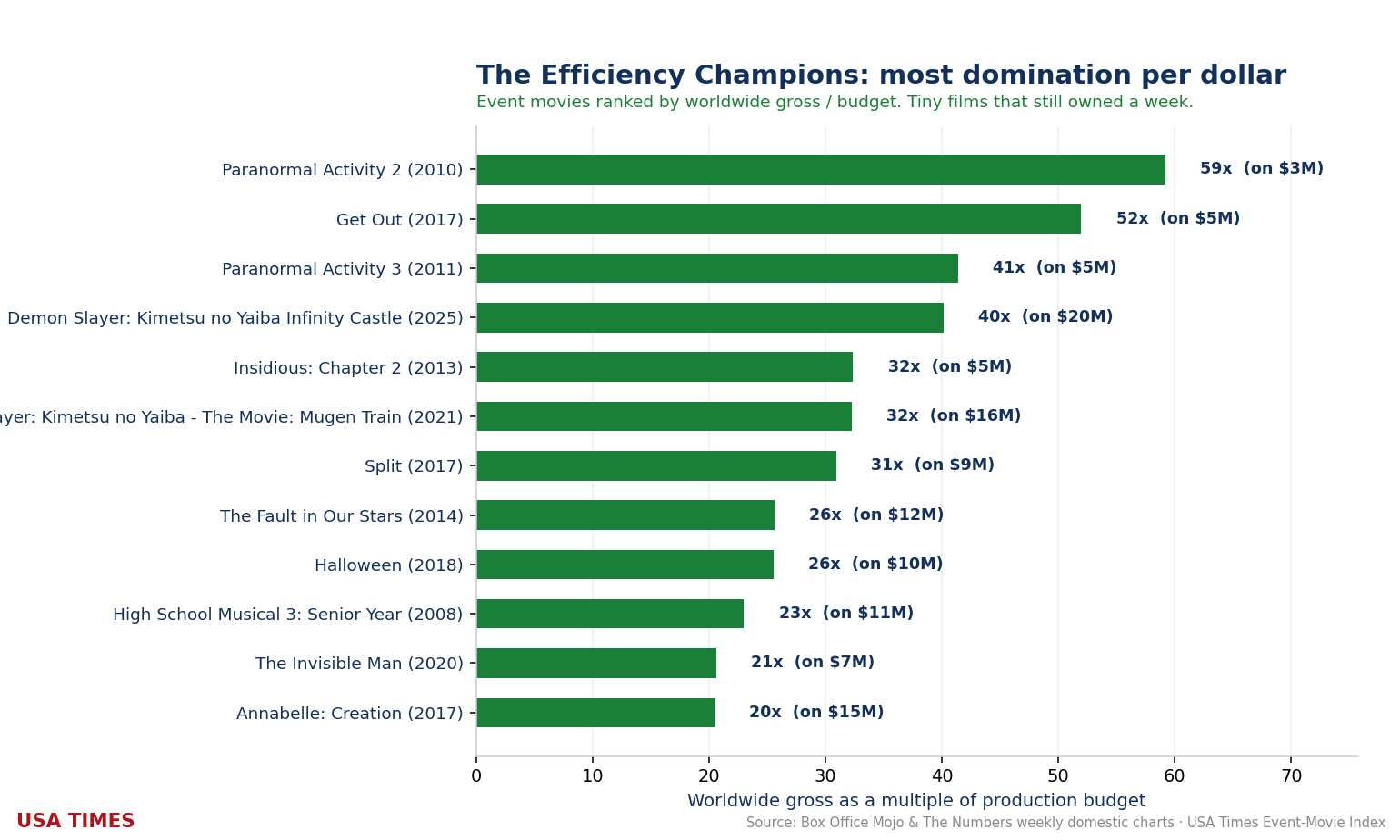
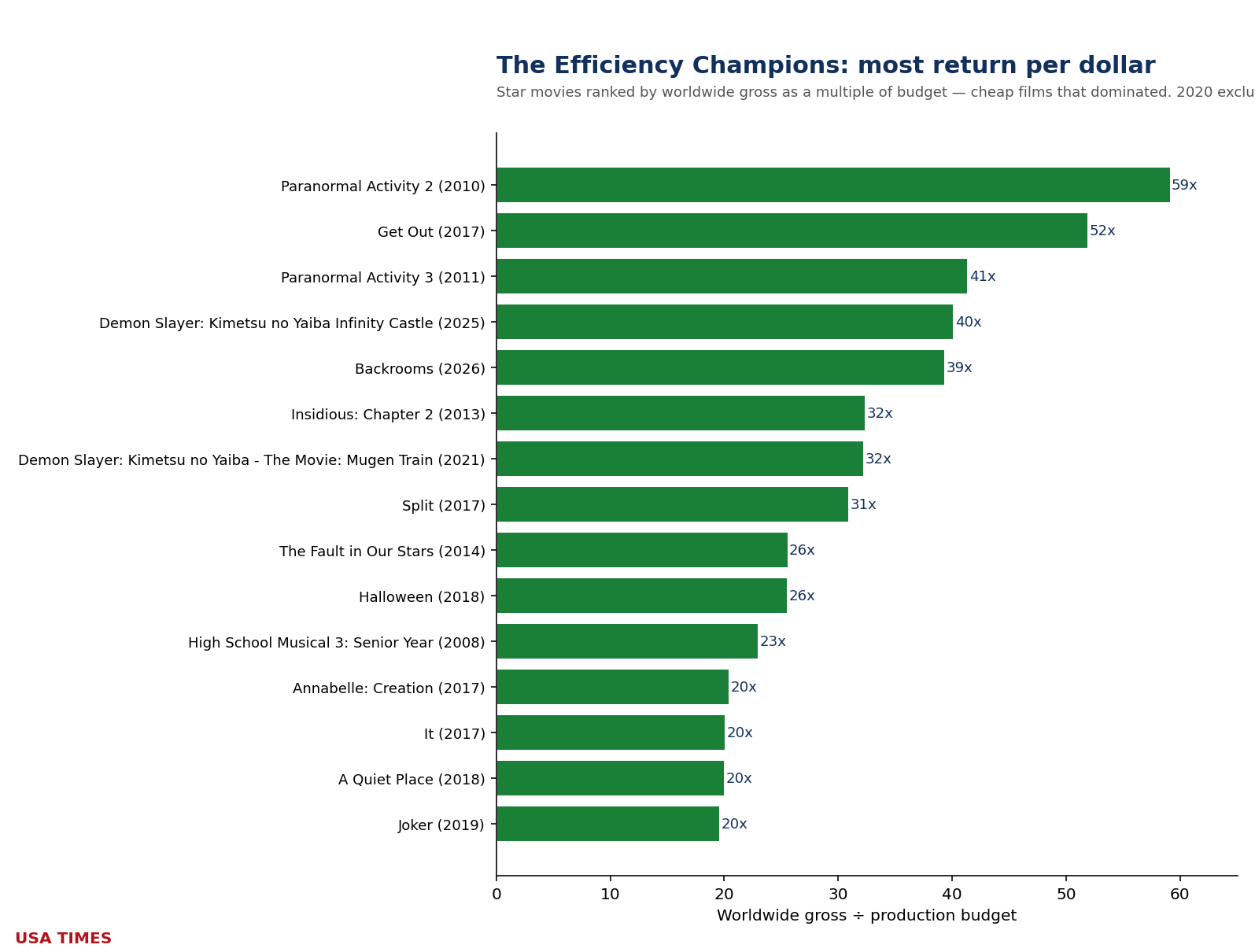
A star movie is usually assumed to be an expensive one — a $200-million tentpole with a marketing budget to match. But domination and cost are not the same thing. Rank every star movie by how much worldwide box office it earned per dollar of production budget, and the leaderboard is ruled not by superheroes but by something far cheaper to make: horror.
The horror economy
At the top sits Paranormal Activity 2 (2010), made for just $3 million and returning roughly 59 times its budget worldwide — all while taking a real slice of a national box-office week. The list is a roll call of the low-budget horror machine: the Paranormal Activity films, Get Out, and the micro-budget scares that built studios like Blumhouse. A found-footage film shot for the price of a single Marvel visual-effects shot can, for one week, own the same throne.
| # | Film | Year | Budget | Return |
|---|---|---|---|---|
| 1 | Paranormal Activity 2 | 2010 | $3M | 59x |
| 2 | Get Out | 2017 | $5M | 52x |
| 3 | Paranormal Activity 3 | 2011 | $5M | 41x |
| 4 | Demon Slayer: Kimetsu no Yaiba Infinity Castle | 2025 | $20M | 40x |
| 5 | Insidious: Chapter 2 | 2013 | $5M | 32x |
| 6 | Demon Slayer: Kimetsu no Yaiba – The Movie: Mugen Train | 2021 | $16M | 32x |
| 7 | Split | 2017 | $9M | 31x |
| 8 | The Fault in Our Stars | 2014 | $12M | 26x |
| 9 | Halloween | 2018 | $10M | 26x |
| 10 | High School Musical 3: Senior Year | 2008 | $11M | 23x |
It is the most democratic corner of the box office. Superhero films buy their domination; horror films earn it, turning a scary idea and a shoestring into a week at the top. In an industry obsessed with scale, the most efficient star movies prove the opposite point — that owning the box office has never really been about how much you spent.
Batmandir · Founders A numbered seat at the table. S3 · The Founders Club — 161 seats per location. By invitation. Explore membership →The economics that make horror unbeatable
The horror genre’s dominance of the efficiency leaderboard is not a fluke of a few lucky films; it is the predictable output of a business model unlike anything else in Hollywood. A horror film can be made for a few million dollars because it needs no movie stars, no sprawling visual-effects budget, and no exotic locations — its scares come from craft, tension, and sound design, not spectacle. That radically low cost base means the arithmetic of profit works completely differently. A tentpole that costs $250 million must gross perhaps $600 million worldwide just to break even; a horror film that costs $5 million is profitable at a fraction of that, and wildly profitable if it connects. The result is that horror can return ten, twenty, even fifty times its budget on a single hit — multiples no superhero film could ever approach.
This is why studios treat horror as a portfolio play rather than a series of individual bets. A studio can green-light ten cheap horror films knowing most will merely break even and one or two will detonate into franchises. The genre’s low cost turns filmmaking into something closer to venture investing: many small stakes, occasional enormous returns, and a downside on any single title that is trivial compared to the catastrophe of a failed blockbuster. The efficiency champions are the winners of that portfolio — the small bets that paid off spectacularly.
Domination on a shoestring
What makes the horror entries on this list genuinely remarkable is not just their return on investment but the fact that they dominated a box-office week while doing it. It is one thing to be profitable; it is another to seize a commanding share of the entire American market on a budget smaller than a single Marvel action sequence. Yet horror films do it routinely, because the genre’s core audience is uniquely reliable, uniquely eager to see a scary film on opening weekend before it is spoiled, and uniquely willing to turn out for a brand-new property with no franchise behind it. Horror is one of the last genres where an original idea, well executed and marketed to the right crowd, can still open to a dominant number without a decade of built-in awareness behind it.
What the champions reveal about the rest of the business
The efficiency leaderboard is, in a sense, a rebuke to the prevailing logic of the modern box office. The industry has bet heavily on scale — ever-larger budgets, ever-bigger franchises, ever-more-expensive spectacle — on the theory that domination must be bought. The horror champions prove the opposite: that the most efficient path to owning a weekend runs through a clever premise and a disciplined budget, not a nine-figure production. If the rest of Hollywood behaved more like its horror divisions — making more films, spending less on each, and letting the audience sort the winners — the box office might look very different, and considerably healthier in its middle. The champions are a standing reminder that in the movie business, as in investing, the return that matters is the one measured against what you risked.
A note on the numbers: return-on-budget figures use reported production budgets, which exclude marketing spend — a real cost that can rival or exceed the budget itself, and one studios rarely disclose. So the true multiples are lower than the headline figures suggest, for horror and tentpoles alike. But marketing scales with ambition too, and the fundamental gap the leaderboard captures — that cheap films can dominate as completely as expensive ones — survives the caveat intact. Domination, it turns out, was never really about how much you spent.
There is a broader cultural point buried in the efficiency numbers, too. Because horror can be made cheaply, it remains one of the few corners of the theatrical business where new filmmakers, new ideas, and new voices can still break through at scale — where a first-time director with a clever premise can end up owning a box-office weekend that would otherwise be reserved for a studio’s most expensive franchise. In an industry increasingly closed to anything without a pre-sold brand, the genre’s low cost of entry keeps a door open. The efficiency champions are not just profitable; they are, quietly, one of the last on-ramps to the top of the box office for anyone without a nine-figure budget behind them.
Related from the USA Times Data Desk
- Wikipedia le atribuye a una película de Bollywood de 1982 casi el doble de la recaudación de Sholay. Sus citas son sobre películas completamente distintas.
- Box Office Tracker: "Minions & Monsters" mantém o 1º lugar e "Michael" ultrapassa US$ 371 mi sem alarde
- You Can Never Have Four: The Hidden Math That Governs the Box Office
- One Movie, Most of the Money: How Total Box-Office Domination Went From Exception to Norm (2006–2026)
- Box-office coverage index · the Star Index methodology